



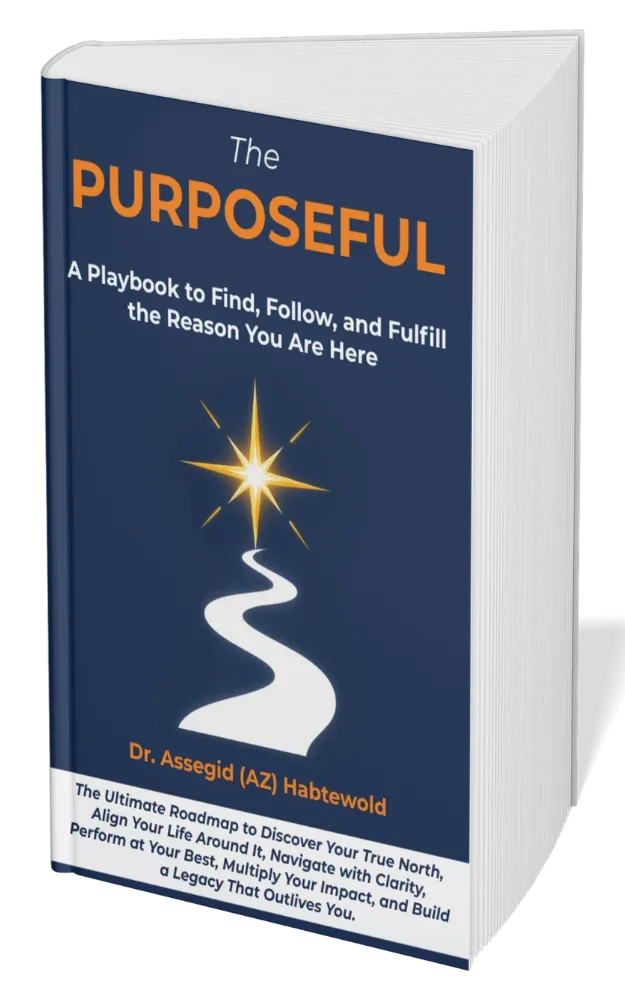
The Purposeful (Sample)
Introduction
Purpose: The Gateway to Meaning and Greatness
"He who has a why to live can bear almost any how." Friedrich Nietzsche, Philosopher, Cultural Critic, and Philologist
Science is beginning to quantify what purposeful people have long experienced. Purpose is not only a philosophical or spiritual conversation; researchers are increasingly examining its relationship with health, resilience, and longevity.
What Does Research Tell Us About Purpose
A 2026 meta-analysis combining 25 samples and 488,765 people across the United States, Europe, and Asia found that higher purpose in life was associated with roughly a 30% lower risk of earlier mortality. The findings don’t prove purpose causes longer life, but the evidence is intriguing: purpose may matter not only to how meaningfully we live, but to how we navigate adversity, aging, and the choices that shape our lives.
Long before researchers quantified this, people experienced it. Viktor Frankl, psychiatrist, neurologist, Holocaust survivor, and author, drew from his experience in Nazi concentration camps to emphasize the power of having a why. Purpose gives us a reason to endure, sacrifice, recover, and continue when circumstances alone give us every reason to quit.
Beneath many of life’s practical questions — what career to choose, what to build, what to walk away from, what will make life meaningful, what we’ll leave behind — sits a deeper question: Why am I here?
Why Many People Avoid Asking “Why Am I Here”
Most people don’t intentionally avoid this question. Life simply gets busy. We study, work, build careers, raise families, and pursue opportunities, and somewhere along the way activity quietly replaces direction. We become busy but not purposeful, successful but not aligned with the reason of our existence.
I know that feeling. Purpose was not always obvious to me. For years I read, reflected, prayed, experimented, and tried to understand why certain causes kept pulling me back. Gradually patterns emerged, and I came to understand something that changed how I viewed my life: Being born is remarkable. Knowing why you were born is transformational.
A Purposeful Universe
Before asking whether your life has purpose, look around you. The heart pumps blood. Roots draw nourishment from soil. Bees pollinate plants. Everywhere we look we encounter patterns, relationships, and interdependence. Whenever human beings intentionally create something — a bridge, software, an organization — we create it for a reason.
That raises a personal question: if purpose surrounds us, why would we assume the human being asking about purpose is the exception? I don’t believe you are. I believe your existence carries purpose too.
Purposeful Intelligence
Human beings possess an extraordinary capacity: we don’t merely exist, we can become conscious of our existence, and ask Who am I? Why am I here? I call this capacity purposeful intelligence — our ability to recognize meaning, discern direction, connect the patterns of our lives, and organize ourselves around something greater than immediate survival.
That ability also creates responsibility. Once you suspect your life carries a deeper assignment, the question changes from Does purpose exist? to What will I do with mine?
Purpose Gives Life Coherence
Viktor Frankl argued that our deepest need isn’t pleasure but meaning, which is why two people can face similar hardship and experience it very differently. Purpose doesn’t remove hardship; it gives it context, answering why we endure, why we sacrifice, and why we get back up.
Purpose becomes a true north. Without it, life’s experiences feel like disconnected pieces. With purpose, relationships, work, sacrifice, and even failure begin fitting into a larger story.
Purpose Is Bigger Than a Job or Title
One of the greatest mistakes we make is reducing purpose to profession. Your purpose is not your job, business, or title. Those are often vehicles through which purpose travels, and vehicles can change. You may teach through a classroom today and a book tomorrow. You may serve through a company in one season and a nonprofit in another.
I think of many of these as mini purposes: meaningful assignments that develop us and often prepare us for something larger. Beneath them may exist a deeper assignment that gives the others coherence. That deeper purpose is the focus of this book.
The Layers of Purpose
Purpose operates at several levels simultaneously:
· Personal purpose (stewarding your own life),
· Family purpose (those entrusted to you),
· Organizational purpose (your profession, team, or enterprise),
· Community purpose (your social contribution beyond your immediate circle), and
· Transcendent purpose — the deeper assignment that aligns the others and answers Why am I here?
These layers don’t compete. When they are aligned, decisions become clearer, energy more focused, and responsibilities that once seemed disconnected become pieces of a larger assignment.
Do Not Wait for Perfect Clarity
Don’t wait until you understand your grand purpose perfectly before living purposefully. Purpose is often discovered while moving.
Early in my journey, I had no polished purpose statement, only clues: recurring interests, responsibilities that kept finding me, a persistent inner pull. So, I volunteered, accepted leadership opportunities, studied, and served.
At the time, much of it seemed disconnected. Looking backward, I can see how it was preparing me. Start where you are. Act on what you know. Pay attention to what you learn. Refine as you go.
The Find → Follow → Fulfill Framework
Becoming purposeful requires more than “finding your why.” A purpose discovered and never acted upon remains unrealized. Purpose must move through three stages: Find → Follow → Fulfill
1. To Find Your Purpose, you discover it, define it, and distinguish it from competing interests.
2. To Follow Your Purpose, you prime yourself, proclaim what you stand for, and pursue it through consistent action.
3. To Fulfill Your Purpose, you move beyond what you can accomplish alone — multiplying your impact through people, mechanizing the work through institutions, systems, and mentoring successors who can carry it beyond your direct involvement, perhaps beyond your lifetime.
The framework provides order, but it is not a cage. Life is rarely linear. You may pursue while still discovering, or mentor successors while the mission is still expanding. Think of it as a map, not a railroad track.
Why This Book Exists
This book expands an idea from my previous book The Highest Level of Greatness: across cultures and generations, the people we consider truly great demonstrate three common traits. They led a purpose-oriented, vison-centered, and values-driven lifestyle.
· Purpose tells you why.
· Vision shows where that purpose could take you.
· Values determine how you travel without losing yourself and compromising what matters the most.
This book goes deeply into the first; companion books will expand the other two traits. Purpose comes first, because without knowing why you are traveling, even a clear vision can efficiently take you in the wrong direction.
Standing on the Shoulders of Others
I’m not the first to wrestle with purpose, nor do I pretend to be. Thinkers and authors such as Myles Munroe, Rick Warren, Richard Leider, and others have helped generations examine why they are here and what makes life meaningful. I’ve learned from their work, built upon many of their insights. And then I approached some aspects of purpose differently.
This book seeks to contribute something further. It charts the entire journey from finding your distinctive purpose to following it through the realities of life to fulfilling it by multiplying its impact and preparing it to continue beyond you. Purpose deserves more than discovery. It needs a roadmap for the journey.
Why Purpose Matters More Than Ever
We live in an age of extraordinary opportunity and extraordinary distraction. Our problem is increasingly not the absence of opportunity but too many directions.
Without purpose, every attractive opportunity becomes a detour and every trend feels urgent. Purpose gives us a filter for abundance and reminds us of a liberating truth: not everything available to you belongs to you.
A Roadmap for Becoming Purposeful
This book unfolds in four parts.
1. Part I: Foundations of Purposeful Living examines life without purpose, life with purpose, and why purpose-oriented living matters.
2. Part II: Finding Your Purpose guides you through Discover, Define, Distinguish.
3. Part III: Following Your Purpose moves from discovery to action through Prime, Proclaim, Pursue.
4. Part IV: Fulfilling Your Purpose moves the journey beyond you through Multiply, Mechanize, Mentor.
The progression is simple: understand it, find it, follow it, fulfill it. Learning the framework may take a few hours. Living it may become the work of a lifetime.
Wherever You Are, Begin There
Perhaps you have no idea what your purpose is — begin there. Perhaps you sense it but cannot articulate it — refine it. Use this framework diagnostically to determine what is missing: clarity, preparation, courage, focus, relationships, systems, or successors. You do not need to complete one stage perfectly before entering another. Recognize where you are and take the next purposeful step.
A Final Thought Before We Begin
Life will demand something from you whether you live purposefully or not. There will be work, sacrifice, disappointment, and change. The question is not whether life will cost you something. It will! The better question is: Will what it costs you serve something worth giving your life to? This book does not promise an easy life. It offers a roadmap toward a more meaningful one.
Keep moving. Keep listening. Keep refining. Keep aligning. And above all, keep returning to the question beneath all the others: Why am I here? Then have the courage to build your life around the answer.
Let’s begin this journey together.
PART I: Foundations of Purposeful Living
(Understanding Before Pursuing)
“True happiness is not attained through self-gratification, but through fidelity to a worthy purpose.” Helen Keller, Author, Rights Advocate, Political Activist
See what happens when life loses its why. Experience what changes when purpose becomes your true north. Build the foundation for a purpose-oriented lifestyle.
Let me begin with two phone calls. Two conversations with people I knew personally. Two accomplished individuals who experienced painful losses and responded in profoundly different ways.
The First Call: “I Lost Everything”
An old friend called one weekend, his voice weak and defeated: “Nothing is up, Assegid. I lost everything.” His marriage had ended, he’d lost custody of his children, and then he lost his job too.
The things around which he’d constructed his life and identity were disappearing one after another. I tried to help him see possibilities beyond his circumstances, but that wasn’t what he wanted. He wanted me to agree there was nothing left. He had built his sense of identity and meaning around what he had achieved and accumulated. When those things disappeared, he felt he had nothing left to live for.
The Second Call: “This Isn’t the End”
Around the same time, an entrepreneur friend (Mentee) called after COVID broke his supply chains: “I wanted to talk to you before I make the final move.” He’d decided to shut the business down, years of effort about to disappear. But he surprised me: “I’m okay. No regret. This business was never my identity. It was a vehicle.” I asked, “A vehicle for what?” He replied, “My mission in life,” then added an analogy I’ve never forgotten: “If one vehicle breaks down, you don’t abandon the journey. You find another vehicle.”
The first friend lost the vehicles of his life and concluded the journey was over. The second lost an important vehicle but still knew who he truly was and where he was going.
Similar Losses, Different Foundation
What made the difference wasn’t intelligence, ambition, or previous success. Both men had all of that. The difference was what their lives were anchored to. One man’s identity had become inseparable from circumstances he couldn’t control. The other had something underneath his circumstances: a why, a mission, a reason to continue.
That doesn’t mean purposeful people don’t grieve. They do! Purpose doesn’t eliminate heartbreak or loss. What it gives you is something meaningful to return to when those things happen. A vehicle can break down without ending the journey. That is the difference between having things to live with and having something to live for.
When the Why Disappears
Nietzsche’s observation captures the heart of this part: “He who has a why to live can bear almost any how.” Frankl placed a similar insight at the center of his reflections on meaning and endurance: human beings can withstand extraordinary difficulty when suffering remains connected to meaning.
But remove the why, and even ordinary burdens become intolerably heavy. Before asking “What is my purpose?” this Part investigates a more fundamental question: what difference does purpose actually make?
Purpose Isn’t an Ego Project
This journey is not another strategy for glorifying the ego. The ego asks, “What can I get?” Purpose asks, “What am I here to give?” The ego seeks pleasure and applause and avoids pain and suffering. Purpose seeks meaning and contribution.
I view purpose ultimately as a journey of the soul, not merely the personality. Our years on Earth matter not only for what we accumulate. It also matters for who we become and what we leave behind. You don’t have to share my exact spiritual beliefs to benefit from this framework. However, you do have to consider a challenging possibility: perhaps your life is bigger than you.
There Are No Small Purposes
We often imagine greatness in terms of visibility. But visibility and significance are not the same thing. The Sun dominates our sky. The much smaller moon quietly stabilizes Earth’s axial tilt and drives the tides. Different roles and scale, but both are essential.
Microscopic Organisms, largely invisible to us, sustain entire ecosystems. A Heart pumps blood and a Brain directs the body, but neither can dismiss the Lungs or smallest Blood Vessels as insignificant. Purpose is not a competition for prominence. It simply has to be yours, and you must fulfill it.
Simeon and Anna never led the kind of expansive, highly visible ministries associated with Jesus and Paul. Their lives occupy only a few lines in the biblical record, while the lives and ministries of Jesus and Paul fill countless pages. Yet these two elders were faithful in their seemingly small assignments, present when they needed to be, and their brief appearances became part of a much greater purpose.
Had they betrayed what was revealed to them about the child Jesus, they could have exposed Him to Herod, who sought to kill Him. Their significance was measured not by how well known and how many pages were written about them, but by their faithfulness to their assignment.
Sometimes a seemingly small purpose plays a vital role in protecting and advancing a much greater one.
Purpose Changes the Way You Experience Life
Imagine two ships crossing the same turbulent sea. Same wind, same waves. But one has navigation. The other is drifting. The storm is identical. The experience is not.
Purpose doesn’t control the weather. It gives you a bearing within it. When you know why you’re here, you gain a stronger basis for deciding what deserves your time, which opportunities deserve a yes, and what you should keep doing when results are slow.
Purpose-Oriented Living Is a Lifestyle
The goal of this book isn’t for you to merely have a purpose statement. I want you to develop a purpose-oriented lifestyle. Your why should increasingly influence your calendar, career, relationships, money, and leadership. Over time, purpose should move beyond a sentence you wrote and become an organizing principle for how you live.
Before You Find Your Purpose, Study Its Evidence
Part II takes you into the actual work of finding your purpose, but a builder doesn’t begin with the roof. Before we search for purpose, we need to understand what life looks like without it, what changes when we have it, and why purpose deserves to become an organizing principle for how we live. In Part I, we begin by exploring:
1. Chapter 1: Life Without Purpose examines drift, confusion, anxiety, and the cost of building identity around things that can disappear.
2. Chapter 2: Life With Purpose turns the picture around — contentment, clarity, courage, and endurance that come when one leads a life with purpose.
3. Chapter 3: The Importance of Purpose-Oriented Living examines how purpose sharpens your uniqueness and affects your work, relationships, and long-term impact.
Ask yourself:
· What is currently holding my life together?
· If those things disappeared tomorrow, what would remain?
· Am I organizing my life around a deeper purpose, or simply responding to whatever demands my attention today?
You will spend your life on something. The question is not whether you will spend it, but what you will spend it on.
Chapter 1: Life Without Purpose
“The greatest tragedy in life is not death, but a life without a purpose.” Myles Munroe, Author, Leadership Teacher, and Minister
Recognize the symptoms of purposeless living. Diagnose the cost of misalignment. See what happens when individuals, families, organizations, and societies drift from their reason for being.
There are illnesses a blood or urine test can detect. There are others it cannot. A friend of mine seemed to be sick constantly for years: blood tests, urine tests, exams, nothing significant ever showed up. One day he told me, “AZ, I think I finally know what is making me sick… I spend most of my waking hours doing something that has nothing to do with who I am or why I am here.”
He began creating room for what he believed he was here to do. A few weeks later, before he told me anything, I could hear the difference in his voice. I’m not suggesting illness is caused by purposelessness. Medical conditions have real biological causes. But his experience taught me something I’ve never forgotten misalignment has a cost.
· Sometimes we pay it emotionally and relationally.
· Sometimes we pay the price professionally, or financially.
· Sometimes the warning is just an inner disturbance whispering something about the way I am living is not right.
When Something Is Used Against Its Purpose
Imagine taking the coffee mug on your desk into your backyard and using it to dig a hole. Could you? Probably. Would it work well? Probably not, eventually it cracks. The hole isn’t properly dug, and energy is wasted. That is what happens when purpose is displaced.
Or imagine writing with your foot instead of your hand, not inferior, just misapplied. Misplacement of purpose can make something highly capable appear incompetent. The problem may not be lack of ability. It may be lack of alignment. What is true of an individual can also become true of a family, team, organization, or nation.
When Purposelessness Becomes Collective
A family without a shared sense of what it stands for can become people sharing a name and address. An organization that forgets why it exists can become consumed by revenue, bureaucracy, or survival.
Think of an ecosystem. Its stability depends on countless organisms performing different functions. Remove one, and the effects ripple through the whole system.
1. What happens when teachers stop educating,
2. What follows when parents stop parenting?
3. What occurs when leaders stop leading,
4. What surfaces when institutions designed to serve begin serving themselves? or
5. What transpires when those entrusted with power use it for purposes it was never intended to serve?
Some poverty, conflict, and dysfunction cannot be explained merely by a shortage of intelligence or resources. Sometimes people entrusted with an assignment neglect it, misuse it, or interfere with the assignments of others. Purpose has consequences. Purposelessness does too.
What Life Without Purpose Really Looks Like
Life without purpose does not always look like failure.
· Activity without direction
· Achievement without fulfillment
· Movement without meaningful progress
You may be moving fast, even succeeding, while remaining disconnected from the reason you are here. That is what makes purposeless living dangerous: it can hide behind success.
1.1 Meaningless Living: When Life Loses Its Why
One of the first casualties of purposeless living is meaning. You can have a full schedule and an empty life. You meet deadlines, raise children, accumulate possessions while quietly wondering: what is all of this ultimately for?
Purpose connects activity to meaning and links what you do with something larger than yourself. Without that connection, life can become a collection of disconnected events: wake up, work, eat, sleep, repeat. Nothing may be terribly wrong, yet nothing feels deeply meaningful.
When the “Why” Disappears
Without purpose, decisions become harder because there is no central reference point. Every opportunity demands consideration. Every attractive offer becomes a distraction. That is why busyness should never be confused with meaningful progress.
Thomas Carlyle captured the distinction: “A person with a clear purpose will make progress on even the roughest road. A person without purpose will make no progress on even the smoothest road.” Reason matters more than speed.
Driving seventy miles per hour in the wrong direction doesn’t solve your problem. It makes it worse. That is the deception of purposeless living: you may be moving very fast, just not toward the reason you are here.
1.2 Living with Hesitation: Doubt and Misalignment
When purpose is unclear, decisions become heavier and murkier. Purpose doesn’t eliminate uncertainty. It provides a filter. Without it, every major decision must be evaluated almost from scratch, creating doubt and hesitation.
The Cost of Living in the Wrong Lane
There is another form of purposelessness: moving, but in the wrong lane. I call this losing your home-court advantage.
· A gifted fish can look incompetent when judged by its ability to climb a tree.
· A natural builder may spend years frustrated in an environment that rewards maintenance rather than creating and building.
· A brilliant writer may appear ordinary in a role that never uses her communication gifts.
Misalignment can make gifted people question their gifts as they compare themselves to people operating in their natural territory. Perhaps the question isn’t “What is wrong with me?” but “Am I on the right lane?”
When Hesitation Becomes a Lifestyle
Repeatedly acting without an internal compass can make uncertainty habitual. You start but retreat, commit but reconsider. Purpose doesn’t guarantee every decision will be correct. It gives you something more foundational: certainty from which to make the decision.
1.3 Fearful and Anxious Living: The Hidden Cost of Drift
When you don’t know what must be protected, pursued, or released, almost everything can feel threatening.
1. A lost job becomes a lost identity.
2. A failed business feels like a failed life.
3. Someone else’s success becomes evidence of your inadequacy.
4. A closed door feels like the end.
Without something deeper anchoring you, temporary circumstances acquire permanent meaning. You become more vulnerable to fear because every loss threatens something you have mistaken for your foundation. The deeper problem isn’t fear itself. It’s the absence of a stable reference point from which to interpret what is happening.
When Drift Creates Inner Distress
A pen is remarkably effective for writing. Use it to dig hard soil, and eventually the tip bends or the casing cracks. The soil is barely moved, and the pen may no longer perform its intended function. Misuse produces two losses: the intended work remains undone, and the instrument itself becomes damaged.
Something similar can happen when we repeatedly drift away from what matters deeply to us. Frustration, restlessness, exhaustion, and anxiety can intensify as we spend our lives pursuing things that fail to provide deeper meaning. We may try to silence those signals through entertainment or constant activity, but eventually the question returns: Is this all there is?
Meaning Changes How We Face Adversity
Viktor Frankl, drawing from extraordinary human suffering, argued that humanity’s deepest concern is not merely pleasure or avoiding pain, but finding meaning. Without meaning, hardship can feel pointless and overwhelming. With a compelling why, the same hardship can be interpreted differently.
· Purpose puts suffering into context.
· Purpose justifies sacrifice.
· Purpose transforms adversity into part of a larger story.
1.4 Discontent, Regret, and Irrelevance: The End Result
Purposelessness rarely destroys a life overnight. It accumulates: one compromise, one postponed dream, one year spent somewhere you know you don’t belong, then another. That is why one of its most painful consequences is regret. Not simply over what you did, but over what you never became.
The Pain of a Misused Life
There’s a difference between being tired and being empty. Purposeful people become tired too, but exhaustion from meaningful work differs from exhaustion caused by years of misalignment. One says, “I am tired because I have been pouring myself into something that matters.” The other says, “I am tired, and I don’t even know why I am doing this.” Over time, purposeless living can produce chronic dissatisfaction, burnout, regret over lost years, and cynicism.
Success Cannot Substitute for Significance
Perhaps the most deceptive form of purposelessness is successful misalignment. You can climb the ladder efficiently only to discover it was leaning against the wrong wall. That doesn’t mean your career or previous experiences were wasted. Many become mini purposes that prepare you for something larger. But they shouldn’t be mistaken for the whole journey. The tragedy is not simply failing. Sometimes the greater tragedy is succeeding at the wrong thing.
The Price of Living Without Purpose
When purpose is ignored long enough, the cost compounds. You may lose clarity, then focus, then years. Purpose is foundational. It influences:
· What you pursue,
· What you reject,
· What you endure, and
· How you interpret success and failure.
So don’t ask only, “Am I successful?” Ask the deeper question: “Is the life I am building aligned with why I am here?”
Reflect and Practice
Reflect
· Where am I busy but not making meaningful progress?
· Where does my life currently feel most aligned—or misaligned—with what matters deeply to me?
· What meaningful contribution or assignment have I repeatedly postponed?
Practice
Choose one major commitment consuming significant time or energy:
1. Decide whether it feels Aligned, Uncertain, or Misaligned with the life you believe you should be living.
2. Write one sentence explaining why.
3. Identify one small adjustment that would create greater alignment.
Do not make drastic changes yet. Awareness comes before alignment.
From Purposeless to Purposeful Living
You can live without consciously discovering your purpose. Millions do. You can work, earn, build, consume, achieve, retire, and eventually leave. The deeper question is whether you are willing to reach the end without knowing whether you gave your best years to what mattered most.
This chapter showed the darker side of the equation. Now we turn it around. If purposeless living can produce meaninglessness, hesitation, fear, discontent, and regret, what happens when we become anchored in a compelling reason for living?
That is where we go next.
Next Steps & Resources
👉 Check out the Table of Contents of the book here...

© 2026: The A to Z Institute, LLC All Rights Reserved