


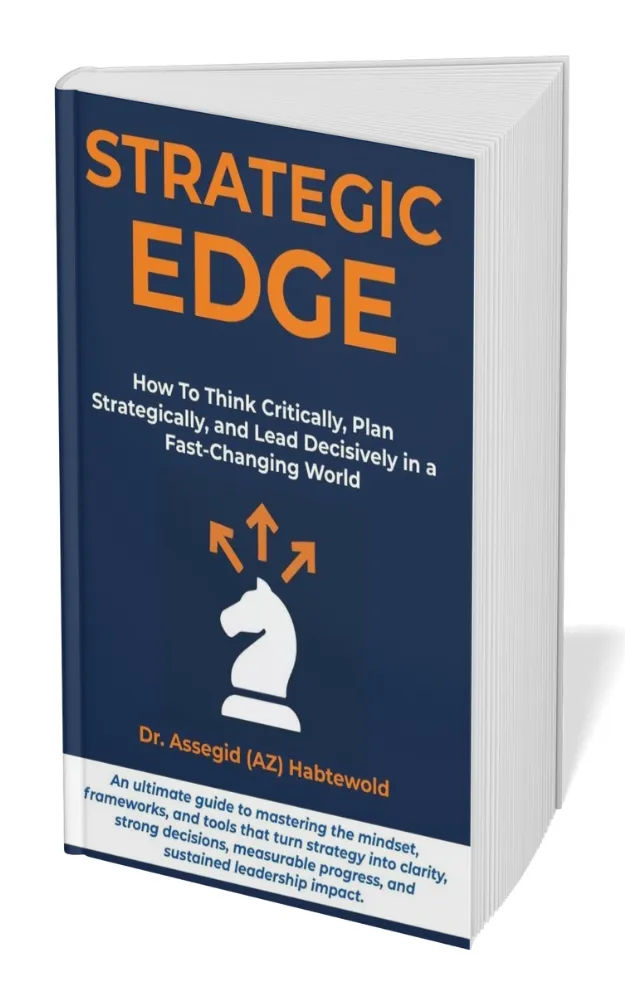
Strategic Edge (Sample)
Introduction: Why You Must Think Critically & Plan Strategically
"You cannot control the future — but you can shape the path that takes you there." Kees van der Heijden, Author and Strategy Expert
I‘ll be honest with you from the start: I didn’t always understand strategy the way I do today.
For years, I saw myself as someone who thought big, understood vision quickly, and could see patterns others missed. But I struggled to translate that clarity into disciplined, consistent execution. I assumed most leaders were wired the same way — until one moment shifted everything.
Early in my consulting career, I facilitated a leadership retreat for a healthcare organization. The room was filled with sharp, seasoned professionals. After hours of dialogue, the CEO — brilliant, respected, and visibly exhausted — leaned forward, pressed his palms together, and quietly said: “We’re doing so much… but it feels like we’re moving in circles.”
That sentence carried weight. This was a capable team. They had talent, resources, and heart. Yet they were stuck — not because they lacked effort, but because they lacked clarity. They were drowning in activity but starved of strategy. They were moving constantly but not moving forward.
As the session ended, I walked outside into the chilly morning air and asked myself three questions that have followed me ever since:
1. How many leaders and teams are working hard but not strategically?
2. How many live in a reactive mode — busy but directionless?
3. How many confuse movement with progress?
Those questions reshaped my life’s work.
Because here is a truth I’ve seen across industries and across continents: People don’t fail for a lack of intelligence, passion, or effort. They fail because they never learned to think critically, plan strategically, and lead with foresight.
Whether I work with start-ups, nonprofits, government agencies, or large corporations, the pattern is the same: Those who pause to think before they act don’t just succeed.
· They stay ahead.
· They adapt faster.
· They create lasting impact.
· They build momentum that compounds over time.
This book exists to help you join that group.
The Reality of Modern Leadership
We live in a world that rewards speed but punishes haste.
Information moves quickly. Markets shift suddenly. Technology evolves overnight. Leadership today is not just about managing tasks. It is about navigating complexity with clarity.
A McKinsey study found:
· Only 22% of executives believe their strategies are future-ready.
· More than 60% admit they struggle to close the gap between strategy and execution.
This is not just an organizational challenge. It’s a personal one.
Many professionals spend their careers on what I call the tactical treadmill — the psychological feeling of running fast yet going nowhere.
1. Calendars stay full.
2. Minds stay overwhelmed.
3. Priorities blur together.
That’s not leadership. That’s survival.
To lead with influence in a fast-moving world, you must do more than act quickly.
· You must think deeply.
· You must think critically.
· And you must think continuously.
That is where your Strategic Edge begins.
Strategic Edge Is Not About Predicting the Future
Foresight scholars and Authors Andy Hines and Peter Bishop remind us that advantage doesn’t come from predicting what will happen. It comes from preparing your mind to see what others miss. Strategic Edge is born from sharpening your awareness, expanding your field of vision, and recognizing early signals that matter.
Most leaders don’t fail because the future surprises them. They fail because they never trained themselves — or their teams — to think beyond the immediate moment.
When you approach the future with curiosity, discipline, and mental flexibility, you make smarter decisions today and position yourself ahead of tomorrow’s changes.
The Mountain Without the Map
Imagine climbing a mountain without a map.
You may have courage, energy, and determination, but you’ll still get lost. That’s what happens when leaders operate with a sense of urgency and tactically instead of strategically. They climb with force but not direction.
Strategy changes that.
· Strategic thinking is the map.
· Strategic planning is the route.
Together, they transform raw effort into intentional progress.
A Short Case Study: From Chaos to Clarity
A manufacturing company once hired me to support their leadership team. They had doubled in size within twelve months, but everything underneath was falling apart:
· Missed deadlines
· Conflicting priorities
· Rising burnout
· Constant firefighting
They weren’t failing because of incompetence. They were failing because they operated in a reactive mode.
We began by clarifying their mission, reshaping their vision, aligning their values, recalibrating their goals, and translating everything into simple execution rhythms.
Within six months, they weren’t just busy. They were focused. They learned to say “no” to noise and “yes” to what mattered most.
As Steve Jobs once said: “Focusing is about saying ‘no.’ I’m as proud of the things we haven’t done as the things we have done.”
Their culture transformed — not because they worked harder, but because they worked strategically.
Why This Book Matters
Strategic thinking and planning are no longer executive-only skills. They are essential for anyone who wants to lead, influence, or grow in today’s complex and competitive world.
Whether you’re:
• an executive shaping organizational direction,
• a professional advancing your career,
• an entrepreneur scaling your business, or
• an investor seeking clarity to assess opportunities, manage risk, and grow your portfolio.
This book makes strategic thinking simple, practical, and actionable. It gives you frameworks you can apply immediately, tools you can use today, and mental models that will serve you for a lifetime.
THE STRATEGIC EDGE MODEL
A Simple Cycle for Thinking, Planning, Executing, and Sustaining Strategically
Before we explore the deeper concepts in this book, it helps to see the leadership rhythm that anchors everything you’re about to learn. This model is simple on purpose — because the best strategic systems are.
1. Think with Strategic Clarity
Strengthen awareness, perception, systems thinking, and pattern recognition.
2. Plan for Strategic Impact
Turn vision into goals, priorities, strategic plans, action plans, and initiatives.
3. Execute with Excellence
Build systems, processes, accountability, and rhythms that convert plans into consistent results.
4. Adapt & Sustain Momentum
Evaluate progress, recalibrate intelligently, and reinforce the habits and systems that drive long-term success.
This cycle becomes the backbone of your strategic leadership — the rhythm behind your decisions and the map for everything you’ll read next.
The Double-Edged Nature of Strategy
Before we move into the four parts of the book, there’s a truth many leaders overlook: strategy is powerful, but not harmless.
Strategy scholar Henry Mintzberg reminds us that strategy gives direction and focus — but it can also create blinders. It can narrow your field of vision, limit dissent, and lead to oversimplification.
His message is clear: Strategy must guide you, not confine you. Strategy is a compass — not a cage.
That’s why strategic thinkers must remain flexible, self-aware, and grounded in continuous learning. This book will help you build strategies strong enough to lead with confidence — but flexible enough to adapt when the world shifts.
What You’ll Discover in This Book
The book is organized into four parts — each one representing a core discipline of high-performing leaders:
Part I — Think with Strategic Clarity
Strengthen your awareness, perception, systems thinking, and pattern recognition.
Part II — Plan for Strategic Impact
Translate vision into goals, priorities, strategic plans, action plans, and high-leverage initiatives.
Part III — Execute with Excellence
Build systems, processes, accountability, and rhythms that turn plans into consistent results.
Part IV — Adapt & Sustain Momentum
Evaluate progress, recalibrate intelligently, and institutionalize the behaviors that drive long-term success.
Each part blends insights, stories, models, tools, and reflection prompts you can apply immediately.
How to Use This Book
Think of Strategic Edge as your personal strategy coach.
Each part has three chapters. Each chapter includes:
· Context — why it matters
· Concepts — frameworks and models
· Case Studies — practical examples
· Tools — methods you can use right away
· Reflection Prompts — questions that sharpen clarity
Read this book cover to cover or jump directly to the section you need. Whether you’re shaping a team strategy, refining personal goals, or preparing for organizational growth, this book will meet you where you are.
This book will help you slow down to speed up — to think before you act, plan before you execute, and lead with clarity when others lead with noise.
Because in today’s world, strategy isn’t just about competing.
It’s about outthinking, outplanning, outperforming, and outlasting.
The future belongs to those who build their Strategic Edge, and this book will help you become one of them.
Part I: Think With Strategic Clarity
“Strategic thinking is seeing ahead while understanding behind, and acting in the present.” Henry Mintzberg, Author and Management Expert
See clearly. Question assumptions. Interpret wisely. Understand systems and patterns.
Everyone thinks. Thinking isn’t the problem. It’s not about intelligence, IQ, or education.
The real challenge is how we think. Most people are never taught to think strategically, critically, or systemically. So the struggle isn’t a lack of ability — it’s a lack of the right approach.
When the approach is off, people fall into predictable thinking traps:
• They think in straight lines, not in systems.
• They rely on old assumptions instead of questioning them.
• They depend on cultural norms that may no longer be relevant.
• They react to what’s urgent instead of reflecting on what’s important.
• They accumulate information but fail to extract insight.
• They rush into decisions without understanding context.
Thinking is natural. Strategic thinking is developed.
And even when people do think, they often think linearly — focusing on isolated details rather than patterns, causes, and consequences. Instead of connecting dots, they simply follow a straight line.
High performers think differently:
• They think critically.
• They challenge assumptions, evaluate evidence, and separate signal from noise.
• They think strategically — zooming out, making connections, anticipating impact, and aligning today’s actions with tomorrow’s goals.
Before you can create brilliant plans, you must first learn to think intentionally, differently, critically, and strategically.
1. Critical thinking is not about being skeptical. It’s about being deliberate. It’s the discipline to slow down, analyze deeply, and separate fact from fiction. It’s learning to see clearly before choosing boldly.
2. Strategic thinking, on the other hand, is not dependent on IQ or titles. It is dependent on your willingness to seek strategic differentiations and advantages in what you do. It’s about perspective, awareness, and the ability to step back from the daily rush to see the bigger picture. It’s connecting insight to intention—and intention to action.
Part I of the book will help you develop and refine your thinking edge:
· How to think critically,
· Analyze deeply,
· Connect patterns others miss, and
· Make decisions that stand the test of time.
In an age of speed, the greatest competitive advantage isn’t information. It’s contextualization and interpretation.
Why Critical Thinking Matters
Critical thinking is the foundation of sound judgment. When you employ such thinking, you:
· Question outdated beliefs
· Identify blind spots
· See bias in yourself and others
· Evaluate ideas with clarity
· Distinguish truth from assumption
· Avoid reactive, emotion-driven choices
Without critical thinking, strategy becomes guesswork and decisions become gambles. At the end of the day,
1. Critical thinking is what anchors you.
2. Strategic thinking is what moves you.
Together, they make you unshakeable.
Why Strategic Thinking Matters
Over the years, I realized that many people confuse thinking with reacting. They spend their days responding to emails, solving emergencies, reacting to events, extinguishing fires, and chasing deadlines—believing motion equals progress. But busyness isn’t strategy. It’s survival on autopilot.
On the other hand, I observed that strategic thinkers deliberately pause, slow down, and reflect constantly. They:
· Lower their brain wavelength,
· Zoom out,
· Question assumptions,
· Connect cause and effect, and
· Ask the hard “why” and “what if” questions before acting.
As Henry Mintzberg, Management Theorist and Author, noted, strategic thinking is reflection before execution—seeing the invisible before it becomes visible.
In a complex world, this ability—to think ahead while understanding what came before—is what separates reactors from strategists.
The Power of a Strategic Mindset
Before you invest in developing competencies that position you and your team strategically, you should build a strategic mindset, a mentality that transforms how you see everything.
When you possess a strategic mindset, it moves you from:
· Tactics to Strategy – from chasing emergencies to focusing on what truly moves the mission forward
· Today’s Problems to Tomorrow’s Direction – from firefighting to intentionally shaping the future
· Reaction to Reflection – from quick answers to meaningful analysis
· Complexity to Clarity – from information overload to insight-driven decisions
When you acquire the psychology of a strategist, you stop drowning in detail and start directing the flow. You think in systems, not silos, in foresight, not hindsight.
That is the foundation of your Strategic Edge. Build it and enjoy its full benefits.
What You’ll Learn in Part I
Before you invest in developing competencies that position you and your team strategically, you should build a strategic mindset, a mentality that transforms how you see everything.
When you possess a strategic mindset, it moves you from:
· Tactics to Strategy – from chasing emergencies to focusing on what truly moves the mission forward
· Today’s Problems to Tomorrow’s Direction – from firefighting to intentionally shaping the future
· Reaction to Reflection – from quick answers to meaningful analysis
· Complexity to Clarity – from information overload to insight-driven decisions
When you acquire the psychology of a strategist, you stop drowning in detail and start directing the flow. You think in systems, not silos, in foresight, not hindsight.
That is the foundation of your Strategic Edge. Build it and enjoy its full benefits.
Chapter 1: Tame Stage Fright
“Sharpen Your Awareness – The Foundation of Critical Thinking.” Unknown
See clearly. Question assumptions. Interpret wisely. Understand systems and patterns.
Before you can think critically, you must first learn to see clearly. Many people jump straight into problem-solving without truly understanding the problem. They collect data, brainstorm ideas, and act fast. But they skip the first step: awareness.
Critical thinking begins with lowering your brain wavelength and slowing down your mind enough to notice what’s really happening, both around you and within you.
When I began consulting leaders early in my career, I realized that most strategic failures weren’t caused by bad intelligence or poor execution. They stemmed from blind spots. Leaders saw the surface—but not the structure beneath it. They reacted to symptoms, not root causes.
One example that changed how I work came from a leadership retreat I facilitated for a community organization. The team was debating how to fix low employee engagement. They had already rolled out incentives, new training programs, even upgraded office spaces—yet the morale score kept dropping.
When I asked, “What’s the real problem here?” the room went silent. Everyone had an answer—but none matched. Some blamed communication, others blamed culture, and others blamed workload. We paused and began mapping patterns over the coming months.
What emerged wasn’t poor engagement. It was misaligned priorities. Teams were overcommitted to short-term initiatives and undercommitted to strategy. Once the group saw it, solutions became obvious to everyone involved.
That’s the power of awareness. It shifts the conversation from symptoms to systems.
1.1. Recognize the Noise: The Enemy of Strategic Thinking
We live in an age of relentless noise—emails, pings, meetings, alerts, breaking news, and endless social feeds. Data shows the average professional checks email every six minutes and spends nearly half the workday reacting instead of thinking. Add 2.5 hours of social scrolling—and it becomes clear why clarity feels rare and attention feels scattered.
But external noise is only half the problem.
There is internal noise too—old beliefs, hidden fears, biases, insecurities, and assumptions whispering in the background:
· “What will people think?”
· “We’ve always done it this way.”
· “This is not how I learned it.”
· “What if I’m wrong?”
And then there is the public noise—popular voices shaping how we think without us even noticing: the news cycle, trends, opinions, cultural narratives, and the “collective urgency” that pushes people to act fast rather than act wisely.
Noise comes from three places:
1. Around you
2. Within you
3. Influencing you
Without awareness, all of this noise blends together—and we mistake motion for progress, reactivity for leadership, and activity for strategy.
I fell into that trap early in my consulting career. I prided myself on being “responsive.” My inbox was my to-do list. My calendar was my compass. But I eventually realized I was working in the business, not on it. My best insights came not when I was typing—but when I was thinking critically and strategically.
So I made a small shift.
Before every major meeting or decision, I take 5–10 minutes of silence. No screens. No inputs. Just awareness. I do the same with my clients—we often begin strategy sessions with 90 seconds of silence. It feels awkward at first, but then the energy changes. People breathe. They see more. They think better.
But awareness is more than quiet. It’s noticing what’s influencing your thinking.
Ask yourself:
· What noise is shaping my perspective right now?
· Am I reacting to reality or to urgency?
· Is this my belief or something I absorbed from others?
· What assumptions are steering my judgment?
· What voices should I turn down—and which should I turn up?
Awareness doesn’t slow you down. It sharpens you.
When you silence the noise—internally, externally, and socially—insight emerges.
The awareness you build in this section becomes the foundation for the next sections:
1. Challenging your assumptions,
2. Asking smarter questions, and
3. Building daily habits that keep your mind clear and strategic.
1.2 Challenge Your Assumptions
Once you recognize the noise around you, within you, and influencing you, the next step is confronting the assumptions that quietly shape how you think. Noise distracts you. Assumptions direct you.
Most assumptions operate below the surface — inherited from childhood, shaped by experience, reinforced by culture, and rarely questioned. Yet they influence every judgment you make.
Research shows that up to 95% of our thinking happens subconsciously, driven by mental shortcuts designed for efficiency, not accuracy. These shortcuts help us survive, but they can mislead us — especially in a rapidly changing world where yesterday’s logic becomes today’s liability.
No wonder why, Peter Drucker, said: “The greatest danger in times of turbulence is not the turbulence itself, but acting with yesterday’s logic.”
We assume:
• The market will behave as it always has.
• Customers think the way we think.
• A successful strategy will remain successful.
• A familiar process is the “right” one.
But unexamined assumptions function like a faulty compass.
They point somewhere — just not always north.
Expand Your Awareness Beyond Your Backyard
Assumptions don’t form in isolation. They grow from the environment you pay attention to — or ignore. Research shows that effective strategic leaders deliberately extend their awareness outside their comfort zone. They scan trends, study unfamiliar domains, engage diverse stakeholders, and seek early warning signals.
By systematizing how they look outward, they prevent internal assumptions from becoming blinders. The environment becomes a thinking partner — broadening perspective, revealing risks earlier, and helping leaders adapt long before competitors do.
Leaders who intentionally expand their field of vision think better because they see more and farther.
How Biases Shape Faulty Assumptions
Assumptions become especially dangerous when fused with cognitive biases — the automatic filters our brains use to interpret information.
Psychologists Amos Tversky and Daniel Kahneman showed how biases such as confirmation bias push us to notice evidence that supports what we already believe while ignoring data that contradicts it. Biases like anchoring, availability bias, and groupthink narrow our thinking even further.
These biases operate subconsciously, shaping what we notice, how we interpret it, and the conclusions we jump to. That’s why strategic thinkers learn to slow down, examine first impressions, question popular thoughts, and ask whether a belief is rooted in facts or simply a familiar mental shortcut.
A single untested assumption can steer an entire strategy in the wrong direction.
A Real Example: The Expensive Assumption
A client I advised believed they were losing clients because competitors offered cheaper pricing.
“Pretty sure,” the CEO insisted.
But when we reviewed exit interviews, the truth was clear: Clients weren’t leaving because of cost. They were leaving because of slow responsiveness.
The assumption wasn’t just wrong. It was expensive.
As the saying goes: “What gets us into trouble is not what we don’t know… it’s what we think we know that just isn’t so.”
Individual vs. Collective Assumptions
Some assumptions are personal. They are shaped by:
1. Upbringing,
2. Identity,
3. fears, or
4. Past failures.
Others are collective — held by teams, industries, or entire organizational cultures.
Collective assumptions are often harder to challenge because they feel like truth. When a belief becomes part of a group’s identity, questioning it can feel uncomfortable — even disloyal.
But organizations rarely break from bad decisions. They break from unchallenged assumptions.
A Three-Step Approach to Challenging Assumptions
Many frameworks exist to surface hidden assumptions, but one simple three-step process has consistently helped me and my clients:
1. Surface the Assumption
Begin by naming what you're assuming. Ask: “What am I taking for granted here?” Most assumptions remain powerful precisely because they remain unspoken.
2. Test the Assumption
Seek facts, signals, or patterns that confirm or contradict it. Ask:
• “What would prove me wrong?”
• “What has changed since this last worked?”
• “What evidence am I ignoring?”
3. Adjust the Assumption
Decide whether the assumption should be refined, replaced, or removed. Ask: “Given what I now know, what does this decision require?”
This approach isn’t proprietary — versions exist across industries and consulting firms — but it is remarkably effective in preventing strategic blind spots.
Before I finalize any major decision, I ask: “What must be true for this to work… and what if it’s not?”
That single question has saved projects, redirected resources, prevented blind spots, and strengthened strategies.
Strategic thinkers challenge assumptions not to be difficult, but to avoid being wrong.
1.3 Ask Better & Thoughtful Questions
Once you quiet the noise around you and confront the assumptions shaping your thinking, the next step is to open your mind intentionally—and the fastest way to do that is by asking better and thoughtful questions.
If awareness helps you see clearly, and challenging assumptions helps you think honestly, asking better questions helps you think deeply and strategically. Each section builds on the previous one, and without this skill, strategic thinking remains shallow.
Asking better questions is at the core of strategic thinking.
Strategic advantage doesn’t come from having all the answers. It comes from having the courage, humility, and discipline to pause and ask the questions that others rush past.
Early in my leadership journey, I took pride in answering quickly. Whether it was a coaching call, a classroom discussion, or a team meeting, I felt pressure from within to respond with certainty and sound knowledgeable. Then I came across a line attributed to anthropologist Claude Lévi-Strauss, who observed that “the wise man doesn’t give the right answers; he poses the right questions.”
That insight stopped me in my tracks.
I realized how often I closed the door to learning by rushing to share what I already knew. I wasn’t thinking. I was performing. From that moment on, I made a conscious shift. I entered meetings with fewer conclusions and more curiosity. Instead of leading with “Here’s what I think,” I began asking:
· “What outcome are we really trying to achieve?”
· “What might we be missing here?”
· “What evidence do we have—and what evidence do we wish we had?”
The change was immediate. Conversations deepened. Clients reflected before reacting. Teams discovered their own answers instead of leaning on mine.
One young manager I mentored struggled because her staff waited for direction. I asked her, “What if you stopped answering and started asking?” Within a month, her meetings shifted from passive updates to active dialogue. “I finally learned,” she later said, “that people don’t follow the person with the loudest answers. They follow the one who asks the smartest questions.”
Great leaders and strategists understand that questions are gateways to insight. They challenge assumptions, spark creativity, reveal blind spots, and invite ownership. The goal isn’t to question everything. It’s to question purposefully, with curiosity anchored in clarity.
· The right question turns confusion into focus.
· It transforms noise into understanding.
· And it keeps learning alive long after the meeting ends.
A Practical Way to Ask Better Questions
There are many questioning techniques taught in coaching, consulting, and leadership programs. One universally accepted simple approach I use with clients is a three-layer question sequence that deepens thinking without overwhelming people.
The Three Layers of Strategic Questioning:
1. Clarifying Questions – to understand context. Examples:
· “What exactly is happening here?”
· “What do we know for certain?”
2. Probing Questions – to uncover root causes and hidden dynamics. Examples:
· “Why is this happening?”
· “What’s driving this behavior or outcome?”
· “What patterns or trends do we notice?”
3. Expanding Questions – to generate possibilities and explore options. Examples:
· “What are the alternative paths?”
· “What haven’t we considered yet?”
· “If constraints were removed, what would we do?”
These three layers move thinking from surface → depth → possibility — the essential progression of strategic inquiry.
Using these three layers prevents shallow conversations. They help leaders move from surface thinking to strategic insight.
How We Climb the Ladder Too Quickly
Another obstacle to strategic thinking is what organizational psychologist Chris Argyris described as the Ladder of Inference — the mental ladder we climb every time we move from raw data → to interpretation → to assumptions → to conclusions → to action. Most people climb this ladder instantly, within few seconds, often based on limited information and personal filters shaped by past experiences, bias, or emotion.
Strategic thinkers learn to slow this climb. Instead of treating their first interpretation as truth, they gather more data, check whether their meaning fits the facts, and—when necessary—come back down the ladder to re-examine earlier steps. This simple discipline prevents them from making decisions based on incomplete or distorted information.
Better questions act as the brake. They interrupt the automatic jump from perception to conclusion. Instead of acting on the first meaning your mind assigns, you pause, clarify, probe, and validate. This single habit prevents premature decisions, unnecessary conflict, and strategies built on shaky conclusions.
Try This:
Before your next move, decision, conversation, or meeting:
1. Write down the decision or problem.
2. Ask one clarifying question.
3. Ask one challenging question.
4. Ask one expanding question.
5. Notice how the problem starts to shift.
Even three well-crafted questions can change the direction of a strategy session, a negotiation, or a performance conversation.
Challenging assumptions and asking smarter questions prepare you for the next step: building daily habits that strengthen your awareness and sharpen your thinking. The next section will help you put these skills into practice consistently so they become part of your everyday leadership.
1.4 Tools to Build Daily Awareness
Awareness is not an occasional breakthrough. It’s a daily discipline — a mental habit you strengthen over time.
Once you learn to recognize noise, challenge assumptions, and ask better questions, the next step is to build routines that keep you thinking clearly, consistently, and strategically.
These simple tools — ones I personally use and teach to leaders, founders, and professionals — help sharpen awareness every day without adding complexity.
A. The 10-Minute Scan
At the end of each day, engage in a 10-minute intentional ritual by asking:
· How was my day?
· What worked today?
· What didn’t?
· What patterns am I noticing?
· What am I avoiding — and why?
· What can be improved?
I personally use this. Some of my best strategic insights began as a single line captured in these evening reflections. Awareness compounds when you review it regularly.
B. The Thinking Journal
You don’t need to write pages every day. But you should capture at least one insight, one question, or one observation per day.
Over time, recurring patterns emerge — revealing where you’re reacting on autopilot, where your assumptions need updating, or where new opportunities are forming.
A thinking journal becomes a private laboratory for strategic clarity.
C. The Observer Technique
Before reacting, pause for a few seconds and imagine watching yourself from above — as if you were an observer, not a participant.
This simple mental shift breaks emotional autopilot, distances you from the immediate noise in your inner world, and sharpens situational intelligence.
I first used it while facilitating high-stakes meetings. It helped me notice tension shifts in a room long before conflict erupted.
Leaders who master this technique make more composed, objective decisions.
D. The Strategic Pause
Before responding, choosing, deciding, acting, or committing resources, ask: “What’s the bigger picture here?”
This question prevents tactical impulses from compromising long-term strategy.
Teams I’ve coached often tell me that a two-minute pause saved them from sending the wrong email, pursuing the wrong client, or doubling down on a flawed idea.
A pause is not hesitation. It’s strategic intelligence in action.
E. Embrace Strategic Paradoxes
Strategic thinking doesn’t mean you eliminate tension. You navigate it. Leading strategically is full of paradoxes:
· Acting decisively while staying open to new information
· Honoring the past while challenging in the presence
· Setting a clear direction while remaining adaptable
· Creating stability while driving change
Many leaders struggle because they try to solve these tensions instead navigating and managing them.
But awareness deepens when you learn to hold both sides without collapsing into extremes. The more you handle contradictions gracefully and comfortable with paradoxes, the more resilient and effective your decisions become.
This mindset ties every tool together: awareness is not simply seeing more.It’s learning to interpret complexity without rushing to resolve it.
Reflect & Practice
Reflection Questions:
1. What distractions or “noise” consume most of your and your team’s thinking time?
2. Which assumptions about yourself, your team, work, market, or stakeholders may no longer be true or outdated?
3. How often do you pause before deciding — and what changes when you do?
Practice Challenge (7 Days):
For the next week:
· Schedule one 10-minute thinking break each day.
· Capture at least one insight daily in your thinking journal.
· At the end of the week, review your notes and identify one recurring pattern worth addressing.
Awareness doesn’t require more time — only more intention.
· When you learn to see clearly, you begin to think critically.
· When you think critically, you begin to think strategically.
· And strategic thinking is the foundation of every decision, priority, and action that follows in this book.
You’ve now built the mental foundation. Next, in Chapter 2, you’ll learn how to connect the dots — turning awareness into insight and insight into opportunity.
Next Steps & Resources
👉 Check out the Table of Contents of the book here...

© 2026: The A to Z Institute, LLC All Rights Reserved