


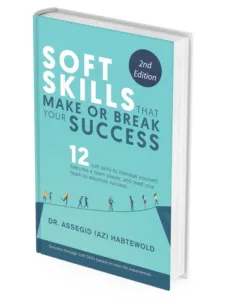
Soft Skills That Make or Break Your Success (Sample)
Preface
Why I wrote the book
I wrote this book because of the following four main reasons. I:
1. Paid dire prices, and I don’t want others to pay the unnecessary consequences I experienced
2. Witnessed colleagues in technical fields hurting their careers and relationships, and I hate to see other professionals have the same fate
3. Watched teams, organizations, and communities suffer and vowed to play my small share to reduce the unwanted consequences of having members who lack people skills
4. Realized that I cannot serve lots of individuals and organizations unless I write a book, which can go where I cannot
I. Paid dire prices
I failed to recognize the critical roles soft skills play in one’s success for many years. My obsession was improving my technical know-how and abilities to excel in what I was doing. I never intentionally invested in my people skills to stay relevant.
I feel embarrassed knowing that I didn’t have the necessary people skills as a professional, business owner, and leader. I wasn’t:
· Self-aware and full of blind spots,
· Managing my emotions and time poorly,
· Scanning and understanding my environment,
· Cognizant and attentive to the needs and feelings of others,
· Facing conflicts and addressing them on time,
· And so on.
As a result, I hurt my health. I struggled to connect, especially with people from different backgrounds and those with differing views, preferences, and styles. Yes, I was hard working and committed, but I wasn’t making progress and advancing as I wanted. I wrote this book because I don’t want anyone to pay these and many other unnecessary prices.
II. Witnessed colleagues hurting
I closely witnessed many of my colleagues in diverse industries, mainly in technical fields, undermining soft skills. I watched them give immense attention and invest in their technical skills, neglecting to work on their people skills. And as a result, they experience setback after setback in their personal life, career, and business. I was saddened to witness how they failed to:
· Discover their uniqueness, leverage their strengths, overcome their limitations, uncover their blind spots, and ultimately tap into their unlimited potential,
· Manage their emotions and scarce resources,
· Solve problems they’re facing quickly,
· Make the right and wise decisions on time,
· Get along with diverse stakeholders,
· Influence the people they lead, their peers, and their superiors.
Mind you. These are highly driven and technically savvy professionals. Unfortunately, they struggled to attract and keep relationships due to their lack of people skills. Though they were producing the most and shouldering the lion’s share, they weren’t the ones leading their team or department or program.
For instance, before I came to the US in 2005, I worked for an international research organization where I had a chance to work with many world-class scientists. Though they were the ones who came up with great research ideas, wrote white papers, and designed innovative research approaches to find answers to some of the most challenging research questions, they rarely led projects and managed project teams.
Back then, it didn’t occur to me. I thought these brilliant researchers didn’t like leading projects and managing people. However, retrospectively, I realized that it could be because they tried and failed. Or they were convinced that they couldn’t succeed without teaming up with colleagues who had people skills.
Where I was working and else where it was common to see technically brilliant researchers without soft skills co-authoring with those who have people skills. They recruited the latter to help them communicate with donors and sponsors. They also wanted them to manage the people side of their projects. They also deferred presenting the papers, giving press releases, and appearing for media interviews for these colleagues who excelled in soft skills.
I wrote this book since I don’t want anyone technically savvy to struggle in representing, communicating, and leading their projects successfully. Of course, unless they wish to delegate these tasks to save time and energy to do other essential things that need their prime attention.
II. Organizations and communities suffer
Whenever someone tells me that their team, organization, or community is struggling, I don’t need to go out and investigate to find out why. I immediately know that one or more of their members lack the people skills included in this book. The struggle is severe when the leaders lack soft skills.
Retrospectively, when I look back, I can easily see how the lack of some soft skills was why the teams, organizations, and communities I was a part of were suffering. They were experiencing many of the following symptoms:
· Poor productivity,
· Missed deadlines,
· Lack of synergy and harmony,
· High turnover,
· Toxic disagreements and conflicts,
· Bickering, scapegoating, backbiting, and so on.
I wrote this book because I don’t want any team, organization, or community to suffer because of a lack of soft skills. I want to provide in this book the necessary resources so that every member may play their fair share for the success of their respective team, organization, and community.
III. Reaching many through a book
You see! I’d not have ever met you in person and shared the insights, tools, strategies, and tactics that could help you succeed in what you do. Since I wrote this book, now, you have the book in your hands.
I hope that once you read the book and practice the lessons you learned in the book, you will also go out to help others around you. With the help of readers like you, I could reach as many people as possible. Together, we could influence others to give people skills their prime attention if they desire to improve their well-being, relationships, leadership, and business.
The good thing is that this book is based on a story. I’m not lecturing you here. You just follow the life of a superstar researcher who experienced a setback because of his lack of soft skills. I hope his story resonates with you.
The story in this book is fictional but realistic. The research organization and its employees illustrate common challenges many companies worldwide may face because of a lack of certain soft skills. As a former researcher and workshop facilitator for scientific and research organizations, the examples are based on my experiences though the identifying details have been changed.
Whether you’re a student, parent, leader, artist, technocrat, doctor, lawyer, or mechanic, it will empower you to take your soft skills to the next level and your career, relationships, leadership, and business.
Notwithstanding in whichever industry you may be operating in right now, your ultimate success depends on your soft skills rather than technical skills. Soft skills are mandatory everywhere as long as two or more people live, work, and do business together.
Wherever you may be now, individually and corporately, you need many of the insights, models, approaches, strategies, and tactics incorporated in this book. They’ll take you to the next level and achieve extraordinary success personally and corporately.
Introduction
Why soft skills make or break
By default, we all strive to succeed. It’s within our DNA. By hook or by crook, every one of us goes the extra mile to succeed, achieve more, and go to the next level. Whether we admit it or not, we all, individually and collectively, have a desire to succeed.
Success, of course, is subjective. It’s in the eye of the beholder. What you consider a success may not be recognized as a success by someone else, and vice versa.
To achieve the success that you’re pursuing, you need empowering habits and discipline; you need to collaborate with diverse stakeholders and lead your team successfully. And this book contains great insights, tools, and processes that empower you to develop the 12 soft skills that make or break your success in life, career, and/or business.
Research conducted by Harvard University, the Carnegie Foundation, and Stanford Research Center revealed that “85% of job success comes from having well‐developed soft and people skills, and only 15% of job success comes from technical skills and knowledge (hard skills).”[i] Unfortunately, many inventors, technocrats, business owners, new hires, supervisors, and managers from diverse industries over depend solely on their expertise. Accordingly, they neglect to develop their soft skills proactively, pay dire prices individually, and cause havoc in their organizations.
Lack of soft skills did cost Tesla
We’ve witnessed many technically genius individuals struggling to succeed because of a lack of some essential soft skills in our history. Nikola Tesla was one such individual. Tesla invented the AC electrical system and coil, which are recognized for laying the foundation for wireless radio technology. On top of these two inventions, Tesla was also a pioneer in discovering technologies such as X-ray, remote control, radar, dynamos, etc.
Sadly, Tesla lacked the necessary soft skills that could have complemented his technical skills. He was unable to communicate his inventions in writing or verbally. He came short of promoting and marketing his discoveries. Tesla failed to hold patents for all of his creations. He was also unable to negotiate to benefit fully from his ideas. At the end of the day, regrettably, his technical genius couldn’t save him from dying poor in solitary.
Wozniak wouldn’t have pulled off Apple alone
In 2016, Forbes acknowledged that Apple outshined its tech peers like Microsoft and Samsung. It’s one of the most valued companies in the world. Behind the formation of Apple were two outstanding individuals- Steve Jobs and Steve Wozniak.
However, regardless of his off-chart technical genius, Wozniak wouldn’t have pulled off Apple without the supplement of Jobs’ soft skills. Even if he could, he wouldn’t have launched it to become a worldwide phenomenon without Jobs’ excellent soft skills. Wozniak admitted that he doesn’t like managing teams and interacting with stakeholders in many interviews and speeches while admiring Jobs’ extraordinary leadership skills.
Millions around the globe wouldn’t have enjoyed the fantastic products of this leading company if the two hadn’t come together and complemented one another. Both Tesla and Wozniak had outstanding technical skills. Unfortunately, these were not enough to attain sustainable success. Only 15% of success comes from technical expertise.
Nonetheless, the difference between the two gentlemen was that Wozniak teamed up with soft skills genius Jobs, who articulated, promoted, and marketed Apple and its products; selected, empowered, and continually inspired Apple’s leaders and team members; negotiated, formed coalitions, and more. Tesla wasn’t lucky to have such a partner. He paid dire prices for the lack of soft skills. Accordingly, he died lonely and in debt.
Startups fail
The same is also true when it comes to entrepreneurship. When some technical professionals see that they are amazingly good at what they do, they are tempted to start a business (or encouraged by well-meaning people to become their boss). They quit their job and open their own business, thinking that their technical skills alone are enough to excel in the business world.
Disappointingly, it’s widely believed that nine out of ten new startups end up unsuccessful. There are many reasons why new startups fail. What you won’t find in the list of why the overwhelming majority of startups die is the lack of technical skills. However, if you sum up all the reasons, they boil down to the lack of certain people skills.
New hires keep getting fired
Not just in the fields of invention and entrepreneurship, but everywhere, the lack of soft skills affects every industry. Let’s just pick the corporate world. There is no shortage of employees. Businesses receive hundreds, sometimes thousands of submissions from overly qualified, technically excellent, and highly experienced applicants for every position they announce. The common challenge all companies face is selecting the right employee with the qualification, experience, and soft skills to fit into the corporate culture and connect with existing team members.
Despite carefully selected criteria, background checks, and contemporary screening approaches, most employers are often disappointed in their choices. In most cases, this is not usually an issue with technical abilities. Mark Murphy- the author of Hire For Attitude, said, “Forty-six percent of new hires fail in the first 18 months, and 89 percent of them failed for attitudinal reasons. Only 11 percent failed due to a lack of hard skills.”[ii] The expertise that brought the new hires through the door could not help them stay there longer and flourish. Companies let go of many of their new hires regardless of their superb technical expertise due to the absence of some soft skills.
Millions are quitting because of managers
Of course, it’s not just new hires that disappoint because of a lack of soft skills. Look around you. Many senior employees, supervisors, and managers also struggle due to a lack of or poorly developed soft skills.
Higher-level positions frequently involve supervisory duties that require excellent people skills. Unfortunately, many companies don’t pay close attention to soft skills when promoting their super achievers. When the latter demonstrate outstanding technical abilities and outperform their peers, they get promoted to lead their team. As a result, they cause havoc.
Common workplace complaints such as high turnover, conflict, lack of synergy, and low productivity levels many companies are experiencing today come down to supervisors' and managers' lack of people skills. For instance, “A Gallup poll of more than 1 million employed U.S. workers concluded that the No. 1 reason people quit their jobs is a bad boss or immediate supervisor…People leave managers, not companies...in the end, turnover is mostly a manager issue.”[iii]
GHR manager caused havoc
Some years ago, Global Health Research (GHR) faced a valuable opportunity for growth when one of its managers- Dan Murphy, entered into conflict with his boss due to a lack of certain soft skills. Dan is an excellent researcher. He is intelligent and creative when it comes to his scientific work.
He had first joined GHR as a doctoral student. He completed his dissertation and later joined GHR as a staff member. While still working on his thesis and following his graduation, his publications brought him admiration and promotion.
Nevertheless, to Dan's dismay, he could not negotiate the promotion without supervisory duties. He wanted to lead the project. But, he didn’t like the accompanying supervisory responsibilities that came with the new title.
Alas, not long after he was promoted, Dan stumbled. He couldn’t successfully get along with his peers and lead his team due to a lack of certain soft skills. His immediate boss got grievances from some of his team members and peers. She investigated the complaints and found them true.
Susan tried her best to help Dan understand the importance of getting along with others. Unfortunately, he refused to admit that he was the problem, let alone make changes and address the issue. The problem persisted. Some key researchers and a few managers from departments that support his project threatened to quit because of Dan’s unacceptable behaviors.
Finally, after trying her best, she decided to remove Dan from leading the project. She didn’t want to ‘lose all’ to retain one. This decision, however, was protested, forcing the CEO of GHR to intervene.
In the next part, I’ll narrate for you the following:
· The genesis of the problem
· The CEO's intervention to save one of his best superstars
· The negotiation to break the deadlock
It is a universal phenomenon
One thing to note here is that though this story occurred in a research company in the US, almost all organizations worldwide face the same kinds of challenges. The good thing is that some companies have realized the significant roles of soft skills. Accordingly, they are willing to invest millions of dollars every year in enabling their people to develop the necessary soft skills.
You, too, should consider empowering yourself and your team regardless of in whichever industry and country you may be in right now. Your people need to develop certain soft skills to master themselves, work with people well, and influence others. And this book is a great starting point.
The book contains the twelve soft skills critical to success in your life, relationships, career, business, etc. These soft skills are industry and culture neutral. They are vital to succeeding in whichever sector and culture you may operate.
Soft skills that make or break your success
Remember that without these soft skills, one may still:
· Find a job,
· Open a business,
· Get promoted, and
· Even take a crucial leadership position, like in the case of Dan.
Nonetheless, it’s unlikely to succeed and serve one’s organization, community, and society extraordinarily without developing these essential soft skills. These 12 soft skills make or break your individual and/or collective success. They are mandatory to attain impactful, lasting, and sustainable success.
They are relevant to all of us
By the way, these soft skills aren’t relevant just for struggling people like Dan. They are critical to all professionals, entrepreneurs, and leaders in any industry worldwide who aspire to succeed. Of course, the success you desire to attain may differ from someone else’s. Regardless, you need to develop these 12 soft skills to continually succeed in what you do.
To whom do you relate?
You might relate to the following characters in this book:
· Dan: You may relate to Dan and say, “That’s me! I’m Dan.” Up until now, you might not have realized how much the lack of some soft skills has prevented you from succeeding in your personal life, profession, social life, business, and leadership. As you read this book, you may be able to see yourself in Dan and relate to his story. This is my hope that, as a result of reading this book, you may start to invest your time and energy into working on those soft skills that you need to succeed in your personal life, at work, and in the marketplace.
· Dan’s team members and peers: You may already know one or more people in your life, organization, community, and business who are creating havoc because of the lack of one or more of these soft skills covered in this book. The story of Dan may inspire you to help your team members, friends, and colleagues understand the significance of soft skills. You may even decide to empower them to develop these soft skills. Or at least, you may give them this book (or other similar books) as a gift, hoping that they may relate to Dan and have the courage to work on their soft skills as he did.
Susan or Paul: I’m sure that there are individuals like Dan in every organization. As a team leader, you may relate to Susan or Paul as you read this book. You may have professionals like him. They have excellent technical expertise, and you don’t want to lose them. At the same time, they’re unable to work with stakeholders well and lead their teams, causing havoc. You might have been thinking of either letting them go while feeling sad or tolerating them regardless of the damages they are causing to your team. Now, as you read about the transformation of Dan, it might give you hope to believe that it is possible to transform your supervisors and managers from being liabilities into assets. This book may also provide you with some insights into approaching such leaders who struggle because of the lack of soft skills. It may also assist you in selecting the right soft skills they need to develop in mastering themselves,, getting along with, and influencing others successfully, and in turn, succeeding individually and contributing their share toward meeting the company’s bottom line.
Lack of soft skills wreaking havoc at GHR
I. The genesis of the problem
Dan manages a multimillion-dollar research project. He reports directly to the program manager, Susan. Though she supervises other managers, he is one of her best producers.
The employees who report to Dan need his help. But, they also fear him. After speaking with him about it several times, two of them scheduled a private meeting with Susan. They acknowledged his expertise, but they accused him of making the environment hostile. After carefully listening and asking follow-up questions, Susan promised to work with Dan. She was confident that he would come around once she clarified how critical it was for him to build appropriate relationships with his team.
To her disappointment, Dan responded defensively. Later, I half-heartedly consented to work on it. After several verbal warnings and a written one for his file, his behaviors remained the same. Dan had assumed that his fantastic research outputs and celebrity status due to his publications make him untouchable.
Marshall Goldsmith was right when he said, “The trouble with success is that…our previous success often prevents us from achieving more success.” Our past success sabotages our current and future success unless we are careful. If what we have been working in our favor, why change? ‘If it’s not broke, why fix it?’ It seems fair, isn’t it? It looks like a no-brainer. But it’s not. Those competencies, behaviors, decisions, and actions that have brought us this far will get in the way and prevent us from achieving the next level of success unless we take proactive measures to upgrade ourselves continually.
Before taking this supervisory role, his lack of some soft skills hadn’t been that much of a problem (at least not one that he’d noticed). Dan had been succeeding and achieving project milestones with relative ease. This success prevented him from realizing the need to make some changes following his new role as manager of a megaproject. Dan’s behavior wasn’t strange to Susan. She worked with other high-achieving researchers. In most cases, the desire to advance had made them take their supervisory roles more seriously.
Susan is an excellent communicator. She tried everything she could for Dan to take her specific feedback seriously. Finally, she gave him the last warning. “If you don’t build rapport with your team in the next couple of weeks, you will no longer be the lead on this project.”
Despite her assurances, she was serious; Dan smirked at her. “You’d never do something like that. No one knows this research better than I do. Doing that would result in a guaranteed failure. I mean, have you met my team?”
Finally, Susan realized that Dan wouldn’t change or quietly give up his managerial position without a fight. Considering his high-profile status and Paul’s high regard for him, she didn’t want to take a unilateral decision without first consulting Paul.
She wanted Dan to succeed. But, she didn’t see how he could continue in his current role without working on his:
a) Personal development,
b) Ability to get along with others, and
c) Leadership competency to influence others.
II. The CEO intervened to rescue one of his superstars
a) Lack of self-mastery as a stumbling block
Susan had kept Paul updated on her hopes for Dan and a couple of weeks ago on her concerns that he wasn’t taking her feedback seriously. Following her latest disappointing conversation with Dan, she reached out to Paul and requested a quick meeting to talk about Dan. The following day, they met in his office.
Paul shifted his attention to business after exchanging quick greetings and inquiring about Susan’s recent family vacation. “How are things going with Dan?” He asked. Susan pulled herself to the sofa's edge, cleared her voice, and explained. “Dan has delivered more than our expectations regarding his project’s milestones. He is hard-working, with extraordinary self-discipline and time management skills. But, Dan does things the way he wants, and when others point out better ways of doing things, Dan gets frustrated, lashes out, and cannot control his emotions and anger. He is incapable of resolving problems before they escalate and cause damage. Dan also makes decisions without involving key stakeholders.”
Paul listened attentively and probed. “What you’re saying is that he doesn’t have personal mastery. Am I correct?” “Exactly!” Susan consented and further elaborated, “Dan thinks that he has all it takes to do the job by himself. He couldn’t see his limitations. Dan isn’t self-aware of some of his shortcomings. Even if some of his team members and I mentioned his blind spots, he wasn’t willing to acknowledge and work on them.”
“We had hoped for better. But I’m not surprised. Too many of these situations end up with someone leaving the organization.” Paul expressed his disappointment. “Do you have any suggestions on how we can work toward a win-win? I know you don’t want to lose Dan. Neither do I. Things have to change if he’s going to stay, though.” He solicited her advice.
Susan wished these were the only failings of Dan’s. And therefore, she remarked, “Paul, these are the tip of the iceberg.” When Paul heard this statement, he knew that he was there for a long ride. Hence, he leaned back on the sofa, sat comfortably, and signaled Susan to continue.
b) Unable to get along with others causing trouble
Once Susan got his attention, she continued. “Dan also failed to get along with others. He is a loner and finds himself productive when he works alone. Dan spends a lot of time in the lab. He firmly believes that spending time with others to know their needs, aspirations, and also the challenges they face is a distraction from his busy schedule.”
Knowing that the behaviors Susan just mentioned are common among scientists, he interrupted Susan politely. “He is a scientist, for God’s sake, Susan!” He then asked her a rhetorical question. “What is wrong with seeking to be alone and spending time in his lab most of the time? Many researchers are introverts and prefer to stay within their world, and these behaviors come with the territory.”
Unlike Susan, whose MBA background, Paul came from a science background. He had been a scientist for many years before he began taking a series of managerial positions in the last two decades.
“You’re right, Paul, the majority of his time should be spent in the lab and alone for him to reflect, read, and write. But, as you already know, his new role as a project manager requires him to interact with both people within his project and outside more frequently.” Susan felt Paul undermined her ability to understand what it takes to be a successful scientist. Even if she doesn’t have a scientific background, Susan is a veteran project manager. Before joining GHR, she had been working with scientists and researchers successfully.
Paul read the facial expression of Susan, which revealed her frustration. To ease the tension, Paul smiled broadly and clarified his point. “As long as he is communicating with the team using technologies and conducting those mandatory in-person meetings and one-on-ones, I don’t see the need for him to spend lots of time with others. You should understand his challenge. He must deliver his promises to our donors, interact with other scientists in his field, and publish and present the results at scientific forums.”
I worked for an international research organization while I was still back home in Ethiopia from 1999 until I came to the US in 2005. In this industry, you either publish or perish. You’re constantly pressured to write proposals, aggressively seek funds, and deliver your promises. It’s a very competitive and high-paced environment. Because of that, many researchers are tempted to spend less time with their team members and other stakeholders to devote more time to surviving and thriving in this cutthroat environment.
Paul’s attempt didn’t work. Instead, it further irritated her. She is well aware that Dan should get enough time to do his job with minimal interruptions. She hadn’t wanted to overwhelm Paul with details, but she didn’t have any choice. “I fully understand his situation. But, if he had invested a fraction of his time alone in his lab to communicate with his team properly, problems wouldn’t have cropped up.”
She further poured out her frustration. “Even those scant communications are mostly via email. Whenever Dan conducts meetings and one-on-ones, he doesn’t provide enough information and context. Dan is disinterested in listening to their opinions and concerns.” She further pointed out that he is impatient as he interacts with people outside of his project. “Not only that, he makes critical decisions without involving key stakeholders. Some of Dan’s team members and peers also accuse him of being insensitive to their culture and religion. Conflict is rampant, but Dan doesn't have the time, interest, and will to address them on time.”
“What did he say about the conflicts?” Paul inquired. Susan groaned and rubbed her head. “He thinks that the conflicts are none of his creations. He blames others. Most importantly, Dan seems oblivious to all the resentment, even though outsiders can feel it just by walking into his department.”
“That is the most common response in my experience. Since we can’t see ourselves without bias, we tend to think that the conflicts we experience are everyone else’s problem. I see that Dan needs to develop his people skills.” Paul shared his observation and asked a follow-up question, “Have you suggested he attend some training courses to improve his people skills?”
While nodding her head, Susan answered, “Initially, yes, but Dan was dismissive. I can’t force him to attend training. And even if I could, what good will it do if he’s not invested in improving and doing better?” “What are his reasons?” Paul wondered.
Susan couldn’t hold back. “He is adamant about not having time. He was sure the project would fall way behind schedule and said he wouldn’t do it even for something that seemed worthwhile to him.”
After a few moments, Paul asked, “Do you agree with him?”
With a slight shake of her head, Susan replied, “It would be a lot of time away from the research, but I can’t help wondering if his team won’t be productive enough to make up for it. His borderline-abusive relationships with his staff certainly aren’t helping the tight schedule.”
Susan’s mention of abusive relationships triggered Paul’s memory. “I can’t remember even seeing him chat with anyone. He always leaves team lunches and birthday celebrations as soon as he’s done eating . . . Will you tell me more about his abusiveness?”
This question was difficult for her. Susan sighed. This is hard to believe because she didn’t have examples. Susan felt disloyal. But did she have any choice?
Before continuing, Susan paused. “Dan hardly ever gives his team members all the information they need. I’m not sure if he knows he is doing it, but I suspect it’s part of his belief that intelligent people can find answers on their own. I guess it's like a test Later, he cuts them out of the most significant works when they fail to meet his extremely high standards. He doesn’t demote them officially, but task assignments say otherwise. That way, he doesn’t have to address the matter at all.”
Though Paul was satisfied with Susan’s response, he decided to push it further. “And when they ask him about it?”
“He refuses to answer. He says things like, ‘If you don’t know, you’re even worse off than I thought.’”
Paul wasn’t about to let this thing go. He wanted to know. “Is he like this with his peers and donors too?”
Susan paused to think about her answer. “Dan does it with his peers. It’s worse. If anything, he doesn’t hold back or leave it for them to ask. He tends to lay it out for them via email. I know some of his donors keep contact with him to a minimum, but no one has complained so far.”
Bending his head down, Paul shook his head. Susan further elaborated before asking another question, “When donors come to observe the project's progress, he makes time for them, but he is quick to dismiss them. He tells them to email him with any questions. That comes back to his work coming first, though. He does respond to the questions right away; he emails them in the evening once he’s left the office. He doesn’t seem to see the value of their active involvement.”
“I see.” Paul looked aggravated. “And how is your relationship with him lately? Have you found him to be receptive to anything you say?”
Another tough question. Regardless, without taking the time to think, Susan explained. “Occasionally, we can find some common ground. He’s quick to remind me that my background is in business and his in science. In general, though, he tells me that everyone is overreacting. He has accused me of trying to make him into someone he doesn’t like. Someone who is more like me.” Both laughed.
c) Failing to influence others getting in the way
Paul looked perplexed. He kept quiet for several seconds. The room froze.
“I see that he needs to improve his communication skills, but what about his leadership? As I've read from your reports, the project seems to be going very well.” Paul was hoping to hear some encouraging reports.
Nonetheless, Susan had none. “Leadership, as you know, is about influencing others to do what you want them to do even more. Unfortunately, Dan has limited influence both within and outside of his project. His team complains that he pressures them to deliver using various techniques, such as some forms of fear and manipulations rather than motivating them to tap into their potential.”
Paul chimed in. “That means he uses old-school motivation approaches that no longer work.” Both laughed loudly.
“Besides, some of his team members also criticized him for failing to invest in them. He expects them to over-deliver his expectations without spending enough time empowering them.” Susan agreed. There was a brief quiet moment. No one spoke.
Susan added, “I also learned that Dan prefers win-lose scenarios rather than negotiating and building the coalition he needs to achieve what he wants.” He also barely participates in the companywide long-term transformation efforts since he is preoccupied with delivering quick and immediate project results.
Susan further gave Paul some incidents to demonstrate that Dan failed to lead his team. These examples painted a clear picture concerning Dan’s struggle to influence others. She shared, almost word-for-word, the argument she had with Dan that led her to believe that he wasn’t going to change.
She then dropped the bomb. “I informed Dan that I’m going to remove him from managing the project unless he demonstrates a turnaround in the next couple of weeks. I came here to give you a heads up since I know how much you value Dan and the hope you had for him.”
Rushing to save one of the bests
Paul looked thwarted. Though he could hear from her voice that she was irritated when she called to set up this meeting, he hadn’t anticipated she would go this far. Who blames him? This news is upsetting to him. He knows Dan’s achievements and hard work. He was hoping that he would continue to excel. However, he cannot undermine Susan. He knows that she is beyond reproach.
After asking a couple of more questions and listening carefully, he realized that Susan had strong reasons to reach this conclusion.
Nonetheless, Paul felt that it wasn’t a good idea to put a demand on Dan like this. And therefore, he expressed his concern that “He may not respond positively to your precondition.” If you remove him from leading his project, he may overreact and take some desperate measures that may not be good for our organization both in the short and long term.
“Removing Dan at this point will be a big loss, and substituting him with another person is even more challenging.” Paul further argued.
“Even if we get someone of his caliber, remember, his project just finished phase one, the donors have tremendous confidence in him, and if they know that he isn’t the one leading the next phases, they may not continue to fund the project. And, I don’t want to take that chance yet.”
Accordingly, Paul suggested a three-way meeting in his office to find a middle ground to resolve the stalemate. He proposed that Dan should be given some growth opportunities before demoting him. Susan said, with a skeptic tone, “I’ve tried that. I asked him to attend some workshops, but he insisted that he didn’t have time. He is also cynical about workshops on themes that are non-technical.”
After sharing his resentment of attending these types of workshops as a scientist and then as a junior manager, he asked Susan to give Dan one last chance. She gave in. “Paul, I’m okay if you decide to give it a try, and you may succeed in changing his mind. But, you should know that some key scientists and managers threatened to quit if he continued with his unacceptable behaviors. We shouldn’t lose all to retain one.”
“I won’t let that happen. If Dan declines to accept my offer and fails to demonstrate improvements within a reasonable period, I’ll let him go.” Paul promised. Susan agreed to the compromise and left Paul’s office. Right away, Paul called Dan, talked to him briefly, and asked him to come to his office on Friday at 1 pm for a three-way meeting.
III. Negotiation to break the deadlock
That triple threat meeting arrived. Both Susan and Dan arrived at the CEO’s office on time. The warm, sunny weather was a stark contrast to what was happening in Paul’s office. Two of GHR’s best minds sat across from Paul’s empty chair. Susan asked Dan about his plans for the weekend. His short answers ended the conversation quickly enough.
Short answers and limited eye contacts are typical for Dan. He doesn’t see the point in small talks, something he had mentioned to his team many times. Dan was also holding a grudge against Susan over an argument they had earlier in the week. Dan hated Susan for having complained about him to the CEO. For that matter, she was the very reason why he was sitting in this office instead of working. He couldn’t wait to be done with this nonsense and return to his lab table. Unlike this meeting, that project was meaningful and was where most of his attention was focused while sitting there waiting for Paul to arrive.
Paul was a little late as he was attending an important meeting outside. After apologizing for being late, he thanked both for coming.
He quickly moved to tackle the issue. Paul planned to directly go to the solution, thinking that if he brought up what had happened between the two, things might go out of hand in an unexpected direction. Besides, he was out the whole morning; thus, he would like to finish this trio meeting quickly and return to work.
However, Dan wasn’t ready to let go so fast. He jumped in. “Paul, before we move on to address the problem, you haven’t heard my side of the story. I don’t see any problem here. Why should we rush to fix a problem that doesn’t exist.”
Feeling guilty for not giving Dan a chance to share his side of the story, Paul nodded his head, signaling Dan to continue. He said, “My bad! Go ahead.” Dan complained. “I’ve met the project's milestones, and things are going as planned. The complaints are unfair and personal. These people don’t like my personality and style of management. I’m a researcher; what do they expect from me? I cannot please everyone. Susan should have known this.”
Paul’s fear just happened. Susan felt that Dan’s last statement undermined her. Susan couldn’t let that go without a comment. “Look, Dan! Your communication skills, style, and approaches weren’t that important when working by yourself. Now, you are leading a huge project. Two dozen researchers are reporting to you. They look up to you. Not only that, your position requires you to interact with professionals from other departments cordially.”
With a visible impatience, Dan responded immediately. “I can lead this project successfully, and things are going well. We are on track. I don’t understand why you should listen to these people and bother me. We just reached a significant milestone and celebrated the success with the main stakeholders. So far, everybody is happy with the results. We are on time and within budget. What else do you expect from me?”
Though he tried to control his emotions and appear calm and friendly, his facial expression, gestures, and voice pitch betrayed him.
Dan is a victim of a psychological condition called cognitive dissonance. Goldsmith argues that cognitive dissonance results from “the disconnect between what we believe in our minds and what we experience or see in reality.” Dan thought that he was successful in his mind in his new role as a manager. Unfortunately, that wasn’t what was happening. The reality on the ground painted a different picture.
He wasn’t alone in blaming others for his predicament. It's counterintuitive and against our nature to first look inwardly and accept responsibilities. When something goes wrong, we point our fingers everywhere. Very few people point their fingers inwardly and take responsibility for working on themselves until they master themselves.
The above were the same lines of arguments Susan had heard repeatedly. “You don’t listen to anyone else but yourself.” Dan’s continual defensiveness disenchanted Susan.
Susan continued, still exasperated. I’ve given you lots of feedback again and again. I expected you to make some changes in your interaction with your team and people from other departments. But you ignored them all. You continued to irritate key people in our organization. These people are sick and tired of being bullied and disrespected. For that matter, you pushed some of them to the extreme. They threatened to quit if you continued to behave like this. You didn’t give me any choice but to lead the project if you don’t improve your approaches.
Mockingly, Dan said, “With all due respect, you don’t know squat about research and what it takes to succeed in this field.” Before Dan continued to utter words that he might regret, Paul jumped in. “Stop blaming one another. We are here to find a win-win solution.”
While calming the two down, he realized in his mind that, unlike his original intention, things heated up, and he lost control. He immediately decided to change his approach. He knew that Dan must be open to change for his proposal to get accepted.
Shifting his weight toward Dan, Paul zoomed in and confronted him. “Dan, we are here because we respect you and want you to succeed. You should be part of this effort, not against it. You are working hard to make sure this project succeeds. You want to have a significant role in managing this big project. You have extreme passion.”
“Unfortunately, it seems to me that you hate the accompanied leadership responsibilities, which require you to come out of your comfort zone. As a successful world-class researcher, you succeed by working hard in your lab and focusing on the quality of your project works. Esteemed journals have been publishing your papers. You have been overdelivering and attracted millions of dollars in funding. No one denies that. We are proud of you. However, the success you have achieved through your hard work alone couldn’t help you excel in your current managerial role.”
Allowing Dan to process what he had just said, Paul paused intentionally. He looked at Dan. To avoid eye contact, Dan looked away. Paul continued firmly. “We want you to succeed in this company. You’re young. The sky is the limit for you in this organization. However, you need to grow in certain aspects of your life, particularly your soft skills, and I have an offer.” He set the tone before putting forward his proposal.
The room was quiet.
It seems Paul’s approach worked. Dan listened carefully and realized that Paul supports Susan’s position and expects him to make some changes. It finally dawned on him that his abilities, such as writing winning proposals, designing outstanding experiments, flawless project execution, and monitoring, were not enough to keep leading the project.
Paul underscored, “The technical skills that propelled you to excel in the lab alone cannot enable you to succeed continually in your current leadership position.” We are here to help you overcome this challenge.
Both Susan and Dan remained silent. Hence, Paul propositioned, “My proposal requires a compromise from both of you.” Paul looked at both and felt that they seemed okay if he proceeded. “Susan, let Dan remain in his position for a while. We should give him ample chances before you take him off from leading the project.”
“Dan, I want you to attend our popular soft skills development program. It’s fantastic, especially for people like you and me whose background is science. I’ve heard great things from many scientists who have attended the program thus far. You know Rafael Arthur, the program manager?”
“Yeah, I know him.” Dan nodded.
“He has been a mentor for some of our young scientists like you over the years.” I’ll ask him to mentor you. By the way, he has a scientific background and is an excellent mentor, and he had also attended the same program some years back.
“Nonetheless, I don’t want you to participate in this program out of pressure. It works if you are passionate about it and take it seriously. Continue to lead the project while attending the program. And later, we’ll come back here again to assess your progress. In the meantime, if you may have any questions or concerns, feel free to stop by at any time.” Paul explained further.
Though Dan wasn’t convinced that attending a training program would make things better, considering Paul's efforts to resolve the conflict between him and Susan, he was obliged to accept the compromise.
However, the real difference-maker for Dan to agree to the offer was the fact that Rafael attended the same program. Rafael is a well-known scientist who, like Susan, manages one of the programs at GHR. Paul paired the two knowing that they could quickly establish rapport as they both have a science background.
The room froze. Both Paul and Susan waited for Dan’s answer anxiously.
He agreed half-heartedly. “Okay, Paul. I see that you’re trying to help here. I’ll join the program and also work with Rafael.”
Paul was happy that Dan took his offer positively and said, “I’m not ambitious, Dan. I know that soft skills cannot be mastered in three months. However, I hope you make efforts to work on your soft skills from now on. I don’t anticipate you demonstrating a turnaround within a short period, but we hope that you will show some improvements.”
Susan seemed content. She didn’t say anything except shake her head up and down to show her agreement with the proposal.
Paul thanked both for coming and agreed to his proposal. He stood from his chair, shook their hands, and led them out of his office.
When he returned to his chair, Paul felt relieved knowing that Dan had agreed to join the soft skills development program, and Susan accepted his proposal.
Both of these leaders are his superstars. He needs them to work out their differences.
Dan is young and has potential. Paul believed that Dan would be convinced once he participated in the program and realized the significance of soft skills.
Paul was confident that once Dan realized how important soft skills were to his success in his managerial position and future career goals, he would invest his time and energy in developing them.
Rafael and Dan met before the start of the program. Rafael shared his experience and how much the program helped him in his managerial roles- first as a manager of a mega project and now as a program manager. He also answered Dan’s questions and clarified his concerns.
They agreed to meet in Rafael’s office the day after each workshop for an hour. They discussed the format and outline of the mentoring sessions. Below are the discussion points they agreed to cover. From each workshop:
1. Dan learned four key lessons,
2. Assessments, processes, models, and tools he found helpful, and
3. Immediate actions he plans to take as a result of attending that particular workshop.
IV. Soft skills development program to tackle the problem
Experiencing mixed feelings, Dan drove to attend the orientation session just one week before the program started. On the one hand, he was worried about being away from the project for one full day each week for the next three months. Dan was concerned that the project team might not function properly in his absence. He was also wondering whether the project might fall behind schedule. On the other hand, Dan was excited since he had accepted the challenge to give this program a try.
Dan arrived at the conference room just before 9 am. While walking to sit at one of the tables in the back, Dan quickly audited the room to see who else was attending the program. He saw some familiar faces. Some participants applied for this program, while the rest were forcefully sent, like Dan or their bosses recommended to participate in this program.
Everyone was seated, eagerly waiting for the orientation session to begin.
Patrick Young is the Senior Program Manager of GHR’s professional development program. Sharp at 9 am, he opened the meeting. Pat has a Ph.D. degree in Biochemistry and is a certified Project Management Professional (PMP). He is a scientist and has extensive experience as a researcher.
However, Pat only spends 25 % of his time at GHR on research work in his current position. He welcomed everyone and briefly talked about:
· Why GHR decided to provide this program to its people,
· The selection criteria used to select participants, and
· The organization’s expectations from each participant.
At the end of his opening remarks, Pat encouraged participants to reach out to him if they may have any questions or needed support. Before stepping down from the stage, he briefly spoke about the training company that won the contract to deliver the program for three years. Next, he invited the facilitator of the orientation session, Karen James, to the stage.
Karen is a very charismatic and articulate trainer. She briefly talked about her education, the companies she worked for, and a few of her hobbies. With her sense of humor and playful personality, she immediately captured the participants' attention. Karen asked participants to introduce themselves briefly and share their expectations from the program.
In attendance, there were 15 people. Some of the participants were scientists like Dan, while others were technical professionals working in the IT, Engineering, and Accounting Departments, while still others were department and section heads.
Participants in this program came from diverse cultural backgrounds. The majority of the participants were from the US. Nonetheless, some participants were from Europe, Africa, South America, and Asia. Participants were also diverse in gender and age.
Many schools failing to equip their graduates
Once the introduction was over, still as friendly and warm as when she opened the session, Karen smiled and continued, “I’d like to start by emphasizing the importance of soft skills.” She gave them some statistics that showed how soft skills play the lion’s share of success.
After sharing a few stories highlighting the critical roles soft skills play in individual and collective success, she then pointed out that soft skills haven’t been given the attention they deserve. “Many schools fail to empower their students to develop certain soft skills while they are still with them before they go out to face the world following graduation. Though they equip their students to do their technical jobs meticulously, many of the contemporary education systems worldwide don’t recognize the pivotal roles soft skills play for the career success of their students.”
While speaking, she scanned the class. She observed that almost all participants nodded their heads concurring with her assessment.
I can testify to that. Whether I was doing my veterinary degree or master’s in computer science, I don’t remember taking a single course or attending any workshop on soft skills.
Not just schools and colleges. For instance, in its State of the Industry Report, the American Society for Training and Development (ASTD) disclosed, “U.S. organizations spent $171.5 billion on employee learning and development in 2010.”[i] Nonetheless, “While 72% of the expenses were allocated to hard skills, only 28 % of those training dollars went to soft skills.”[ii] If 85% of career success comes from soft skills, the latter should have been given proportionate funding and attention. But, the above statistics from ASTD shows the reverse.
Few invest in the soft skills of their people
After a very brief pause, Karen pushed on. “Once students are graduated, that is when the real challenge surfaces. As you have already experienced, most jobs require communicating with superiors, peers, and internal and external clients.”
We communicate more than we would like to admit. I remember reading one of MIT’s surveys. It reported that scientists and engineers spend more time communicating rather than doing their technical work in the lab and workroom. If professionals in technical fields devote most of their time to communicating, you can imagine how much professionals in other fields may spend.
“Our success in fulfilling our job description and meeting our personal and organizational goals requires developing certain soft skills.” Karen further argued. “Unfortunately, many organizations are unaware of this fact. And therefore, they fail to empower their people to develop those soft critical skills necessary for them to undertake their job, get along with, and influence others successfully.”
Karen paused. No one interjected. She interpreted their silence as permission to continue. “The good thing is that GHR has made a serious commitment to invest in the soft skills of its people. That is why we are here.” Karen admired GHR’s decision to invest in this soft skills development program.
After another long pause, she opened the floor to questions. “Any question, comment, or thought about the importance of soft skills?”
From her experience, Karen realized that many technical professionals struggle to accept that the lack or underdevelopment of some soft skills may get in the way and prevent them from succeeding and advancing up the corporate ladder. She anticipated some resistance. That was why she opened the floor to questions before talking about the program and how it works.
However, the first question she got had nothing to do with soft skills.
Defining hard skills
Kelley Johnson is an African American who is recently promoted to lead the Human Resources Department. Before her promotion, she was the head of the employee engagement section. Kelley has a sense of humor. Kelley always smiles even when she asks tough questions. She also provides tough feedback with ease.
Kelley wondered, Karen, I heard you mentioning hard skills a couple of times. I’d like to be on the same page with you. What do you mean by “hard skills?” Karen redirected the question to the class. A couple of participants ventured and defined hard skills.
For instance, Kofi Solomon- originally from Ghana and Facility Manager at GHR- defined, “Hard skills are tangible abilities and know-how we use to accomplish a task, whether the task is in our backyard, workplace, or marketplace.”
Antonio Raul, like Dan, is a project manager of another megaproject at GHR. He defined hard skills as follows, “Technical skills are those abilities we use to perform hands-on duties.”
Karen attentively listened to the definitions proposed by the participants and acknowledged that these are great descriptions. But, she reminded the class that there is no one perfect definition we all must agree on. Once the class was on the same page concerning the meaning of hard skills, she asked, “Any other question?” Participants seemed to be accepting the meaning.
Dan questioned the significance of soft skills
One of the things that have been bothering Dan since the issue of soft skills surfaced in his professional life was the importance they have been given. He felt that both Susan and Paul blew the significance of soft skills out of proportion. He couldn’t take it any longer as he listened to Karen glorifying soft skills over technical skills.
He firmly believed that technical expertise is more important than soft skills, especially in organizations like GHR. And hence, he expressed his skepticism. “From the recent discussions I had with some of my colleagues, and now from your presentation earlier, I cannot stop thinking that soft skills have been given more prominence than they deserve as if they are more important than technical skills. I disagree.”
Some participants chuckled. Karen smiled warmly and kidded. “Dan, you’re saying that soft skills are overrated.” Even Dan smiled while the rest laughed out loud. “Joke aside, you’re right. Technical skills are critical. Without technical expertise, it’s unlikely that one could fulfill their job description. Every team, business, and organization in any industry needs some key set of hard skills to succeed and meet its mission.”
Technical skills help to get in
Karen continued. “It takes hard skills to set one’s foot in. It’s unlikely to perform one’s duties without technical know-hows successfully.” She went ahead and further built her case:
· “An accountant without the hard skill of math knowledge is lame. No one hires such a handicapped accountant.
· An IT help desk professional who lacks hard skills such as disassembling and reconstructing a Computer, installing software, antiviruses, antispyware, and other technical expertise such as troubleshooting should not be working at the desk.
· A surgeon without the necessary technical skills should not be allowed to pen anyone.
· A lawyer who doesn’t know all the laws in the area where he represents his clients doesn’t qualify to serve clients.
· The list continues…
But, we need to develop and hone certain soft skills if we desire to enjoy success in what we do.”
Defining soft skills
Krishna Anil is a scientist from India. He came to Karen’s aid. “I concur. Though technical proficiencies in any field are mandatory, as far as we are working with others, hard skills are not enough to succeed in any career.”
Lucas Arthur is the Head of Logistics at GHR. He was curious. “What are soft skills?” As usual, Karen redirected the question to the participants.
Many hands were raised, but most of these hands were from those who had been very active. Thus, Karen gave a chance to Natalia Kamil.
Natalia is a second-generation Polish woman. She leads the social media section within the Marketing Department. She explained. “Hard skills are job-related knowledge and abilities that we have to fulfill our job description. On the other hand, soft skills are intangible and may not directly relate to the jobs we are hired to perform but are essential to succeed in our roles.”
Some used interchangeable words such as “human skills” and “interpersonal skills” in place of “soft skills.” Others narrowly defined “soft skills” as communication, emotional intelligence, and mindfulness.
“Soft skills aren’t just those abilities we need to communicate and connect with others. In this program, they’ve got wider applications.
They’re competencies necessary to control oneself, collaborate with, and ifulence others. Without developing and refining these soft skills, one can’t do extraordinary things and become successful in any endeavor. They complement technical competencies and result in undeniable success.” Karen clarified.
Karen moved on and made a quick disclaimer. “By the way, the twelve soft skills we’re going to cover in this program can’t empower us to succeed unless we develop:
· Positive attitude,
· An optimistic outlook, and
· Hopefulness.”
Soft skills for corporate success
It’s impossible to meet our corporate goals solely depending on our people’s technical abilities. The workplace needs team members who have developed certain soft skills more than ever. The latter contributes to a more productive, harmonious, and fruitful work environment, leading to collectively achieving irrefutable results.
In response to NACE’s Job Outlook 2016 survey, employers look for out of the ten skills when they hire. These soft skills include the “Ability to verbally communicate with persons inside and outside the organization, Ability to work in a team structure, Ability to make decisions and solve problems, Ability to plan, organize and prioritize work, and Ability to obtain and process information.”[iii]
Difficult to find team members with the right soft skills
James Brett is a senior grant writer and manager of the grant office that interacts with both internal and external clients as it provides grants for qualifying research proposals. James weighed in. “Some of us are challenged to appreciate the significant roles that soft skills play because they are elusive. It’s harder to quantify these skills compared to hard skills. But, we can quickly recognize when we see individuals who have developed and fine-tuned their soft skills. These are the ones who contribute the lion’s share toward the overall success of their team and organization. And it is not that hard to identify such individuals.” Karen nodded her head in agreement. “I couldn’t agree more with you, James. You nailed it!”
I’ve talked to many managers. They don’t think twice about letting go of team members who are technically savvy without soft skills. Even if they graduated at the top of their class, they prefer to retain those with equivalent technical know-how coupled with people skills. This choice is straightforward. You can always quickly find someone with superb technical skills for almost most jobs. But, it’s tough to find someone who has the necessary technical skills plus the soft skills essential to getting along with the existing team.
Does soft mean weak?
Dan remarked dryly. “On one hand, we’re talking about how soft critical skills are and how tough it’s to develop them. On the contrary, we use a label like ‘soft.’ If you ask me, it’s confusing.”
Without waiting for Karen’s reply, Dan asked skeptically. “Don’t you think that the word ‘soft’ may be taken as ‘weak’?” Some participants looked at one another and shrugged as if to say, ‘I don’t.’ Not Karen. She took Dan’s question seriously.
Karen paused for several seconds and clarified. “The word soft shouldn’t diminish the significance and power of soft skills. People shouldn’t take the word ‘soft’ literally. They shouldn’t also assume that ‘hard’ means strong and tough. Developing soft skills is tougher than developing hard skills.” Dan looked unconvinced.
Karen continued. “By the way, there are soft things that are also strong. Think about silk. Little insects produce it. Yes, it’s soft. But, it can be as strong and tough as steel. Likewise, developing soft skills doesn’t equate to becoming ‘soft’ in its literal meaning. Actually, developing soft skills enable you to become tough whenever necessary.”
However, she admitted that the term ‘soft skills’ has been controversial. “By the way, we know that the term is contentious. Many people associate it with weakness. There are also people who argue that it is inaccurate, hard to measure, and gender-biased. As a result, we tried to find an alternative fitting name that could show a parallel with technical/hard skills without success. We brainstormed and came up with alternative names such as interpersonal skills, people skills, adjunct skills, non-cognitive skills, 21st-century skills, etc. However, none of them appeared to be the best fit for this program. Though we recognized that some people might find it inaccurate and even dislike the word ‘soft’ in soft skills, we thought the term is universally known.”
Hard skills and soft skills complement one another
Karen looked at her watch and realized that she was running out of time. However, she didn’t want to conclude the current discussion like this. And thus, she decided to give the class an example that demonstrates how soft skills supplement hard skills and their critical roles. Though Karen’s background is in computer science, she used a simple analogy that everybody could understand.
Karen explained it as simply as possible. “A computer may be packed with powerful hardware such as a high-speed processor and a large memory chip. It cannot even boot without the aid of an operating system (software), let alone function and execute your tasks properly. Similarly, hard skills without the support of soft skills are lame.”
Participants quickly got the point Karen was trying to communicate except Dan. He seemed confused. “Software by themselves is useless. They need the right hardware.” He protested.
“Yes, both need each other. Unfortunately, many professionals misplace their focus. They undermine the place of soft skills. They keep working on their technical knowledge and abilities, neglecting to invest in their soft skills.” Karen clarified.
International Talent Management Strategist and Coach- Dorothy Dalton used a relevant analogy to explain the complementary nature of hard and soft skills. She wrote, “Hard skills are the foundation of a successful career. But soft skills are the cement.” In construction, it’s impossible to have any enduring foundation without using cement. It’s used to glue rocks and other hard materials together to build a solid foundation.
Primarily because of a lack of awareness, many undermine the critical roles of soft skills. Very few understood the rightful place of soft skills at the early stage of their career. These are the ones that have avoided paying dire prices that come from failing to work on soft skills, which take a relatively long time to develop.
Upgrading both hard and soft skills
Dmitry Egor is an immigrant from Ukraine and is the new Chief Information Technology Officer. He complemented the analogy Karen used earlier. “When we are requested to upgrade our computers for better performance, we don’t go out to purchase the latest hardware just because they perform better than the existing ones. We upgrade the operating system (software) and software applications.
Otherwise, the new hardware (CPU and memory chips) may not be compatible with the existing software. Even if the two systems (both the hardware and operating system) are compatible, without the right upgrade, the applications that are running on our computers cannot deliver the performance improvements we desire.”
“Thanks, Dmitry!” Karen complimented. “We need to develop and fine-tune our soft skills as we continue to improve our technical skills. We need to upgrade both proactively.”
Measuring the progress of soft skills is harder
Fernandez Juan is a senior scientist from Mexico. He marveled. “You said soft skills are intangible skills, so how can we measure whether we are making progress?”
Karen enjoyed the active participation of the class. Even those who weren’t asking and commenting participated by nodding their heads.
She underscored, “Both hard and soft skills need improvement. It’s easier to evaluate the improvement we make in our hard skills. I agree. It may not be that easy in the case of soft skills.” She then suggested, “Seek feedback from the people you work with to see if you’re making progress on your soft skills. You may also consider having coaches and mentors to get feedback and progress consistently.”
The three parts of the program
As the orientation session approached to end, Karen quickly explained the purpose of the overall soft skills development program and the three parts that would be covered in the coming twelve weeks:
· Part I: Mastering Self,
· Part II: Getting Along With Others, and
· Part III: Leading Others.
“Each of you has a folder. There are important materials within each folder, including a welcoming letter, an outline of the program, and dates and places where each workshop will be held.” Karen further clarified. Next, she walked participants through the outline, introduced some ground rules, and then gave them a chance to ask questions about the program.
Why only 12 soft skills?
Martha Michael manages the Procurement Department. She used the opportunity and asked, “Why only just twelve soft skills? Are these the only soft skills we need to work on?”
“No! These aren’t the only ones. But, these are the bare minimum. These twelve soft skills make or break our success.” Karen admitted and suggested, “However, while working on these crucial soft skills, it’s good to continually work on our other soft skills to solidify our success.”
Are the soft skills only for leaders?
Some participants weren't done even if she was out of time and visibly rushed to conclude the orientation session. Without raising his hand and waiting for Karen’s permission, Kofi hurried to ask. “Are these skills needed only by those who are leaders and would like to become leaders?”
Karen quickly answered. “Our company strongly believes that everyone is a leader in the area of their passion. Each employee needs to develop leadership skills to fulfill their respective responsibilities in the workplace. These twelve soft skills are essential for all who desire to attain success in what they do, regardless of whether they have official leadership titles or not. Our journey toward achieving indisputable success in what we do requires mastering oneself, getting along with, and leading others. And, this program is designed for those who would like to succeed in what they do, including those who are already leaders and those aspiring to become leaders.”
Some participants raised a couple of more clarification questions. Karen briefly answered all of the questions. The orientation ended successfully.
No more excuses…
Dan used the return trip to think and reflect. He remembered how he began this journey by complaining and feeling cornered. The orientation session convinced him of the significance of soft skills to succeed as a manager of a megaproject. It changed his attitude.
Now, he started to see how much the organization valued him. He was given a second chance rather than letting him go or immediately demoting him. Not only that, they decided to invest thousands of dollars in helping him grow. They allowed him to have a flexible schedule that permits him to succeed on both fronts (research and training) for the next three months.
As he drove back home that afternoon, Dan was a different person. No more defensiveness and complaining. He took on some responsibilities and promised to have a new attitude. That was a great start. Marshall Goldsmith recognized twenty habits that pose serious challenges to successful people. One of these habits is making excuses. Goldsmith wrote, “If we can stop excusing ourselves, we can get better at almost anything we choose.”[iv] Dan got rid of this habit before even starting the program.
By the way, we are all the products of our decisions. Our own actions determine who we are and where we are in life. But, very few are daring enough to take responsibility. Earl Nightingale was right when he said, “We are all self-made, but only the successful will admit it.”
Slowly but surely, Dan began to embrace what had happened. He considered the experiences thus far blessings in disguise. He felt that everything worked out in his favor. Dan got another chance to prove to his superiors, colleagues, and team members that he was ready to take his leadership to the next level. He is up to the task, positive, and prepared to be an active participant in this program.
Be proactive
Think about this. Dan is a very successful researcher whose unique talent and experience the company desperately needs. He was successful when working as a solo researcher on his thesis. He was celebrated and promoted because he had outstanding technical skills that gave him a competitive advantage as a researcher.
The challenge began when he was promoted to lead a megaproject. That was when the lack of certain soft skills surfaced. They didn’t push him out for fear of jeopardizing the current project and the future fund attraction he brings to the table.
What would have happened if he were any regular John Doe? He would have been fired right away without the CEO knowing about it. And nobody would have missed him. Take a moment to think about those people your company has been letting go of. How many of them got a chance like Dan? Very few or none…
We need to work on our soft skills proactively. We shouldn’t wait until the lack of certain soft skills brings us in front of our superiors. By then, it could be too late. We may not have the same leverage as Dan. We may not be able to negotiate and get a second chance as he did.
Developing our soft skills is significant in the 21st-century, where customers are kings. On top of getting along with people within our team, we are expected to collaborate with and influence both internal and external customers. The stakes are high in this very competitive era. We are expected to over-deliver, not just in what we do but also in our interactions with others.
Therefore, whether you are a young professional or an entrepreneur, an aspiring leader to climb the corporate ladder, a technocrat in the field of science or politics, a community leader, a politician, or a business owner, your ultimate success depends heavily on your soft skills rather than your technical abilities.
I’m glad that you’re reading this book. I’m sure that the following three parts will give some great insights, tools, processes, and methods that can help you improve your soft skills that make or break your success. Good luck!
Part I: Mastering Self
“The height of a man’s success is gauged by his self-mastery; the depth of his failure by his self-abandonment… He who cannot establish dominion over himself will have no dominion over others.” Leonardo da Vinci
Better people, better company…
If an organization desires to experience continual success, it needs to invest in the personal growth of its people. Zig Ziglar advised organizations by saying, “You build a better company by building better people.” Individuals become better as they continue to grow. The more people grow, the more they attain personal mastery.
People with personal discipline get along easily, lead others better, and contribute their share to improving their organizations. Unfortunately, many companies want their people to get along and lead others without first investing in their personal growth. They don’t hesitate to spend millions of dollars on in-house or external programs that aim to develop the managerial and leadership skills of their supervisors, managers, and executives.
Nowadays, nonetheless, this trend seems to be changing. System Scientist Peter Senge indicated that empowering their people to have personal mastery has attracted many organizations. He acknowledged that these companies “recognize that an organization develops along with its people.”[i]
Self-mastery is a win-win
Some companies have also begun to understand that workers in the 21st century are not just one of the means of production like they used to be. They recognized that employees of the new century don’t have the Industrial Age mentality any longer. In his book “The 8th Habit”, Stephen Covey argued that workers were considered as things like capital and machines in the Industrial Age. The ultimate goal of the Industrial Age management was to be efficient with things, including the individual. As Covey wrote, “When all you want is a person’s body, and you don’t really want their mind, heart or spirit (all inhibitors to the free-flowing processes of the machine age), you have reduced a person to a thing.”[ii]
Unlike “Companies [of the nineteenth and twentieth centuries that] wanted “hire hands” who were not paid to think, who checked their brains at the factory gate”[iii], Ed Oakley and Doug Krug stated in their book ‘Enlightened Leadership’ that the 21st-century workplace is filled with knowledge workers. Most of these workers don’t come to work for paychecks alone. The majority aspires to use their job to pursue their passion, maximize their potential, and get fulfilled in life. That is why this is the responsibility of 21st-century organizations to assist their knowledge workers in increasing their self-awareness and ultimately attaining self-mastery, which is a win-win for both the individual and the organization.
Knowing self is true wisdom and power
Another strong reason why 21st-century organizations should prioritize personal growth is that it gives their people true wisdom and power. The ancient Chinese philosopher and writer Lao Tzu declared, “Knowing others is intelligence; knowing yourself is true wisdom. Mastering others is strength; mastering yourself is true power.” The journey to get along and lead others successfully should begin with knowing and mastering oneself. And this part of the book is dedicated to narrating the discussion on self-mastery, followed by the subsequent workshops on the four soft skills necessary to master oneself.
First day of the program
On the first day of the Soft Skills Development program, Dan arrived 15 minutes before 9 am. Around seven participants had already taken their seats. The room was silent. Many of the participants were sipping coffee. Some were checking their emails on their smartphones. Others were reading newspapers, and still others were working on their laptops.
The room was set up for fifteen participants. Each circle accommodates three people. There were five small circles.
Introduction…
The facilitator of this program was Joe Muller. Joe is an experienced soft skills trainer with years of experience. He was assigned to facilitate this program because he had a science background and was a researcher before becoming an instructor.
As Joe began the first workshop by introducing himself (though they already knew him from their email interactions), his experience as a researcher, what he has been doing as a trainer with the current company, and his expectations from this program. Next, he gave the group a purposeful icebreaker: to meet five attendees who were not at their table and spend two minutes max with each person to introduce themselves, what they do, and share their expectations from the program. Participants walked around, greeted one another, talked, and listened.
Areas of focus to achieve self-mastery
Once the icebreaker was over, Joe displayed his slide that showed the outline of the program. He explained, “Succeeding in our career requires us to master ourselves, get along with, and lead others. And today, we’re going to cover the first topic under Part I, Increasing Self-awareness.”
Joe reminded participants, “First, I will give you a little background about the importance of self-mastery before we dive into the first workshop.” He then continued. “Personal mastery begins by increasing our awareness of who we truly are, our strengths, and limitations.
Personal mastery can be achieved not only by being aware but also by controlling what is happening inside and around us.” He further indicated, “We need to start this rewarding journey by expanding on our existing self-awareness. Increasing self-awareness is the foundation of self-mastery. We then continue to develop self-mastery on this foundation by:
· Developing the skill to understand and control our emotions,
· Managing the time and energy, we have at hand,
· Solving problems that we face daily by making ethical and right decisions.”
100% self-mastery is unachievable right away
“Is it possible to master self a hundred percent?” Joe asked a rhetorical question. The whole class murmured and said a big No. No. No.
Joe joined the class while smiling and said, “No. No. No. We’re not here to attain perfection. When we designed this part of the program, we knew that attaining 100% self-mastery is impossible.”
He is absolutely right- a hundred percent self-mastery is unattainable. The journey of personal mastery takes a lifetime. Even then, it may not be possible to climb and stand on the peak of the mountain of self-mastery. Very few individuals have been lucky enough to achieve this daunting task in their lifetime.
Self-mastery is a continuous process
After a brief pause to give participants enough time to process what he had just said, Joe continued, “We also believe that this journey is continuous. You all have begun that voyage, and you’re somewhere right now. We trust that you’ll continue on this expedition and work on yourself long after this program is over. This is our hope that you will take from this program some valuable insights, techniques, and tools that will empower you to continue improving your self-mastery. Self-mastery is a continuous process and a lifetime task.”
Total self-mastery in all areas is impossible
“Let me see a show of hands,” Joe asked, “How many of you think mastering yourself in every area of your life is possible?” No one raised their hands. “No one could master self in all areas of her/his life,” Joe stressed.
Joe broke participants into small groups and told them to identify areas that contribute toward personal mastery and prioritize them according to their importance. Once the discussion was over, he asked each group to report the top 2 areas of focus to the whole class.
Let me share the seven dimensions Ziglar identified in his book ‘Born To Win: Physical, Family, Mental, Financial, Spiritual, Career, and Personal.
Once the reporting was done, together with Joe, the class narrowed down the list to five focus areas. Joe then gave them an individual exercise. He told them to gauge their level of mastery for each category.
Next, Joe smiled broadly and encouraged participants. “Don’t worry much if you don't have a high rating for some areas. The most important thing is that wherever you may be on the scale right now, keep working on those aspects of your life consistently.” Joe is right. Ziglar advised, “You must master some degree of success in each area of life before you can experience the true satisfaction of total success.”[iv]
Self-mastery is the prerequisite to influence
“Has direct self-mastery relevance to leaders like yourselves?” Joe asked. Almost all heads nodded in agreement. “Why is that?” Joe probed, seeking participation from the group.
A couple of participants shared their take on the relationship between self-mastery and leadership. They argued that everything begins with oneself. Before we lead others, we must lead ourselves first.
Joe consented. “You guys nailed it. Before we successfully get along with others as team members and influence others as leaders, we need to master ourselves. Our company firmly believes that impactful leadership begins with leading oneself first. Also, we cannot lead ourselves effectively unless we have some form of personal mastery. Self-mastery is the foundation for getting along with and influencing others. In this program, four important soft skills have been selected to enable you all to attain self-mastery.”
Leadership begins with self. Counterintuitive?
Usually, Dan prefers to listen and take notes when he attends workshops. He doesn’t jump to share his thoughts or ask questions in a large group. Nonetheless, Dan was determined to become proactive in this program and push himself out of his comfort zone. And therefore, he noted, “Interesting! You’re saying that leadership begins with self. It looks counterintuitive, don’t you think?”
“You’re right!” Joe agreed and elaborated. “When people think of leadership, they think of others. The main reason is that hundreds of leadership definitions portray leadership as if it’s about others: inspiring, motivating, guiding, and influencing others. These undertakings are necessary, but impactful leadership's starting place should be self.”
Joe clarified passionately. “Many cultures nurture their inhabitants to seek dominance by conquering some ‘mountains’ out there before they master self first.” Joe’s point aligns with Jim Whittaker's statement, “You can never conquer the mountain. You can only conquer yourself.”
It seemed like participants wanted to hear more, so Joe further pushed. “Many individuals come up with lists of mountains they would like to conquer, but they fail to subjugate any. Very few people start the journey of attaining extraordinary success off on the right foot by mastering themselves first.”
Analogy- Climbing Mount Everest
Sensing that the idea he was talking about hadn’t hit home yet for some of the participants, Joe decided to use a metaphor. He hoped that this analogy would get through to them. “Mount Everest stands tall as the world’s highest mountain, at over 29,000 ft. More than 4,000 people have stood on its top, out of billions of humans. It’s a perilous mountain. Aspiring climbers prepare for years, or at least months, before setting their foot near this giant creature. They knew what was at stake! So far, close to 300 people have died attempting to climb this massive mountain. I bet those who climbed Everest had disciplined themselves first- they did their homework before taking on Everest.”
Most participants nodded their heads. They had heard or read about Everest. They already knew that Everest was a no-nonsense mountain. No one could climb it without enough preparation and discipline.
We all have ‘mountains’ to conquer
As an experienced trainer, Joe tied the analogy with the theme of the discussion. He recognized the fact that many of us don’t believe that we could be able to climb the world’s towering mountains. And therefore, we don’t try at all. But, almost all of us have ‘mountains’ in life and the career that we would like to climb.
“What are your mountains?” Joe smiled and asked a rhetorical question. “Of course, your mountains are different than mine and someone else’s.” The expressions on their faces said, “yeah.”
Desiring to involve them, Joe asked another question. “What are the mountains that you aspire to climb?” Joe paused for several seconds. Surprisingly, no one ventured. It seemed they weren’t yet ready to reveal their ‘secrets.’
Thus, Joe continued to answer his question. “By the way, some of you may have mountains in life and profession that are grander than ‘Everest.’ There is nothing wrong in being ambitious as far as you are willing to match your efforts with the size of your dream. As you attend this program, some of you might have already climbed a few of your mountains and now looking forward to conquering more. Some of you might be climbing your dream Mountain right now and very close to the top. In any case, good for you! You've done your homework before climbing your mountains, and now you’re reaping the benefits of personal mastery in those areas you have conquered. But, many of us are struggling to climb our ‘Everest’ one step at a time. And thus, we need to keep working on ourselves first to succeed in our adventures.”
“For those of you who are still climbing, the question is: where are you in climbing your mountains in life and career?” Joe asked playfully.
With a big smile, Dan inquired: “I’m at the lower end of many of my mountains. People like myself, what should we be doing?” The whole class cracked up.
Once the laughter was subsided, while still laughing, Joe continued, “For those who haven’t begun yet or at the lower end of their mountains- like Dan (pointing at Dan), it isn’t too late to stop wherever they are, step down, and regroup and do their homework first if they haven’t yet. It’s okay to restart. It’s better than reaching close to the top and returning to the base, or worst, ‘dying’ in trying to climb our mountains because we haven’t first disciplined to master ourselves enough.”
Though Dan said that he was at the lower end of many of his mountains, he really advanced quickly in his profession. And then, he stumbled and almost fell off. The good thing is that Dan made the right decision to return to the base to regroup. If he had rejected the offer to join this program and work on himself, he would have been like those who continued to climb their mountains and died because they refused to work on themselves first.
Butterfly 1st conquers its own world
If we review the lives of those who succeeded, they disciplined themselves before endeavoring to climb their mountains, which were outside of their control. A butterfly flying high in this 'brutal' environment today wouldn't have made it if it had failed, as a caterpillar, to break through its little, safe, and comfortable world (its shell) first. Likewise, to be successful (climb our mountains) and fly high (like a butterfly), in this highly competitive world, we need to master ourselves first (while we’re still ‘caterpillars’).
As a coach, consultant, and trainer for some government agencies, technology companies, and non-profit and community organizations, one of my jobs is to empower leaders to develop self-mastery. I train, counsel, and advise leaders to increase their self-awareness using well-developed and tested concepts, approaches, tools, and assessments. I also equip them to learn how to manage their emotions, time, and energy, solve problems creatively and make tough decisions ethically.
As a result, I found that these leaders’ ability to get along and lead others increased tremendously. On the other hand, it’s common to witness people who haven’t spent enough time influencing themselves struggling to work with and lead others. And when that happens, most of the time, the results aren’t pretty!
Unfortunately, unlike the caterpillar, life allows humanity to ‘fly’ even if it hasn’t yet fully developed and broken through its ‘shell’ first. Those who may think that they have broken through their ‘shells’ and now they’re free to ‘fly’ as they wish without self-mastery are mistaken. Epictetus said, “No person is free who is not master of himself.” To succeed and fly high in this world, influence and lead others, we need to be free first. And the ticket to that freedom is personal mastery.
The 1st & greatest victory is conquering self
Great philosophers have been reminding us to make our precedence right. For instance, Plato said, “The first and greatest victory is to conquer yourself.” Those who failed to heed this wise advice learned the truth after facing hurdles after hurdles before coming face to face with the truth. The truth is that mastering oneself comes before mastering anything else.
Whether you’re a leader or a professional, or a business owner, or a community organizer, or a politician, or someone passionate about climbing a 'mountain' for fun or entertainment or just to see how far you could climb, if you overcome the unruly and undisciplined inner world first, you will definitely climb your ‘mountain’ in the outside world, which is more brutal, competitive, unforgiving, and deadly. We can fly high and attain our dream when we outgrow ourselves and the safe environment (our shell). It’s a matter of time!
Self-aware leaders are authentic
Once the class was on the same page about the importance of self-mastery, Joe briefly shared his company's philosophy concerning self-aware leaders, “We strongly believe that self-aware leaders are authentic. They had first influenced themselves and walked the talk before they attempted to influence and lead others.”
Joe’s line of argument aligns with Steven Covey, the author of “The 7 Habits of Highly Successful People”, who proposed to have private victories before seeking public victories. In this classic book, he called the first three habits to lead to private victory. And the following three habits public victory. Covey rightfully argued that achieving the former makes it easy to achieve the latter.
Plutarch also said it well. “What we achieve inwardly will change outer reality [in the outside].” Sadly, many leaders are tempted to start leading from the outside in. In his #1 National Bestseller book entitled ‘Leadership From The Inside Out, Kevin Cashman wrote: “People who project themselves entirely into activity, and seek themselves entirely outside themselves, are like madmen who sleep on the sidewalk in front of their house instead of living inside where it is quiet and warm.”[v]
Self-leadership is a prerequisite for lasting leadership
Joe further explained his company’s leadership philosophy. “Leadership is elusive for many because they think that the places where they become better leaders are public arenas as they lead others. Unfortunately, the foundation of impactful leadership is self-leadership.
· Understanding who we’re, our strengths and limitations,
· Conquering our thoughts and regulating our emotions,
· Managing our time and energy,
· Overcoming obstacles and solving problems, and
· Making wise decisions and demonstrating a commitment to our decisions are where we learn how to lead ourselves first.”
“Without first conquering self, the chance to prevail upon anything else outside of which we don’t have control is a huge hurdle, to say the least.” Joe underlined.
Self-leadership is a prerequisite for lasting and impactful leadership. The molders of great leaders are those private dens where these leaders had been shaped before they came out to take leadership initiatives to influence others. However, that doesn’t mean that those who didn’t get a chance to lead themselves first aren’t qualified to lead others. What they need to do is to keep working on themselves and lead themselves well while leading others. Dee Hock- CEO of VISA International, said, “If you seek to lead, invest at least 50% of your time leading yourself”.
A leader who has never won himself first cannot stand a chance to influence others successfully and continually. Even if he gets the chance, he will not be able to exert influence for an extended period. If one fails to lead herself over whom she has full control, how can she lead others over whom she doesn’t control?
As the legendary painter, Leonardo da Vinci said, “You will never have a greater or lesser dominion than that over yourself…the height of a man’s success is gauged by his self-mastery; the depth of his failure by his self-abandonment.” He continued, “And this law is the expression of eternal justice. He who cannot establish dominion over himself will have no dominion over others.”
Leading self is the greatest challenge
While self-leadership is a prerequisite for lasting and impactful leadership, it’s not easy to lead self. In one of his leadership conferences, when the leadership guru, John C. Maxwell, was asked what has been his greatest challenge as a leader, he surprised the audience. “Leading me! That’s always been my greatest challenge as a leader”.
In his book ‘Leadership Gold,’ he noted. “I think that’s true for all leaders regardless of who they lead and what they accomplish. We sometimes think about accomplished leaders from history and assume that they had it all together.”[vi] He gave some examples, “But if we really examine their lives, whether we’re looking at King David, George Washington, or Winston Churchill, we’ll see that they struggled to lead themselves well.”
Joe glanced at his watch and realized that they had stayed too long on the importance of self-mastery. Joe displayed the self-mastery process and explained the process very briefly. And then, he opened the floor to questions.
Fig. 1: The Self-Mastery Process
It was an interactive discussion. Due to space limitations, I can’t narrate everything. Nonetheless, let me quickly summarize the main points for you:
Self-Awareness
· Self-awareness is the first and most critical stage of the process.
· At this juncture, almost everyone has some form of awareness.
· The goal of passing through the initial stage of the process is to expand one’s awareness at both ends- to continue elevating the already existing consciousness while also expanding beyond the current knowledge level into new territories.
· Increasing self-awareness takes time and consistent efforts.
· It also demands choosing one’s battle. Choose a couple of top self-awareness areas that could bring significant enlightenment, and make them your top priority.
In his book ‘The 80/20 Principle’, Richard Koch wrote, “80 percent of outputs result from 20 percent of inputs; that 80 percent of consequences flow from 20 percent of causes; or that 80 percent of results come from 20 percent of efforts.”[vii] Identify those 20% awareness areas that could bring 80% awareness improvement.
· Here are some of the questions to ask to choose your areas of focus. Am I:
· Cognizant of whom I truly am?
· Aware of my passion, talent, uniqueness, strengths, and limitations?
· Are you conscious of the dominant thoughts I entertain in my mind the majority of the time?
· Is it mindful of my prevailing emotions?
· Able to manage my scarce resources, such as my time and energy, wisely?
· Are you capable of solving problems and making quality decisions when faced with critical choices? And so on. Answering these questions helps you know where to invest most of your time and energy.
· Asking the right questions is mandatory to increase our awareness.
In her book ‘Change Your Questions Change Your Life’, Marilee Adams disclosed the power of asking the right questions. She wrote, “Questions open our minds, our eyes, and our hearts. With them, we learn, connect, and create. And with them, we can create better futures and better results.”[viii]
· Workshop one covers increasing self-awareness.
Self-Management
· The previous stage is knowledge acquisition. The second stage uses the new awareness to manage oneself and develop self-control.
· It’s impossible to achieve self-control in every aspect of one’s life.
· Choose a few focus areas to have control over emotions, time, energy, and problems.
· Without a handle on one’s emotions, self-control is unthinkable.
· Self-management cannot be done without managing one’s time and energy.
‘Unless time is managed,’ Peter Drucker said, ‘nothing else [including self] is managed.’
· Likewise, it is hard to control oneself without having a good handle on the problems and decisions that one faces consistently.
· During the second stage of the self-mastery process, the individual may struggle to have personal mastery. When the individual no longer struggles to control self, the person has transcended to the next stage, which is self-mastery.
· Though the heavy lifting of self-mastery resides in the second stage, where the person takes proactive actions to manage self, it doesn’t mean that the first and the last stages aren’t important.
· Self-management leads to self-mastery and contributes toward effective management beyond self.
Shad Helmstetter, an expert in neuroplasticity and personal growth, wrote: “I believed that mastering one’s future must surely start with managing one’s self.”[ix] He further argued, “All of us are ‘managers’ of one kind or another … Effective management always begins with successful self-management … True leaders have their own selves firmly in control; they are in command of their actions, their feelings, their attitudes, and their perspectives.”[x]
Peter Drucker, too, underscored that self-management is the basis for effective management when he wrote, “That one can truly manage other people is by no means adequately proven. But one can always manage oneself. Indeed, executives who do not manage themselves for effectiveness cannot possibly expect to manage their associates and subordinates.”[xi]
· Workshops 2 - 4 cover the three soft skills mandatory to manage oneself.
Self-Mastery
· Once someone manages themselves successfully, they enter into the self-mastery phase.
· Unlike the first stage, where knowledge is acquired, and the second stage, where self-control is practiced, this stage is a state.
· Those who increase their self-awareness and practice self-management finally attain personal mastery.
· Self-mastery is a cycle. Once someone masters those things- the things they become aware of, with the new mastery comes new territories for which one doesn’t fully know. This leads to repeating the process, starting with self-awareness, self-management, and self-mastery.
· The process of self-mastery repeats itself continuously until one reaches the point where the person will have fewer and fewer things that they are unaware of. Passing through this process as many times as possible allows us to unleash many of our unknown strengths and talents and uncover lots of our blind spots and vulnerabilities.
Before concluding the discussion about Part I, Joe showed the class the direct relationship between part one and the following two parts of the program. He explained that the skills developed to master oneself and the experiences gained as one passes through the process will empower the individual to get along with and lead others. Joe clarified, “The skills, experiences, and tools you will acquire as you work on your personal mastery are going to help you:
· Understand the purpose, gifting, talent, needs, aspirations, strengths, and limitations of your team members and know how to help them tap into their uniqueness and strengths to contribute their share to the team and organization's success.
· Develop emotional intelligence to recognize the emotional state of the people you work with, demonstrate empathy, and use this competency to drive performance within your team.
· Improve your ability to manage the time and energy of your team effectively to advance the goals of your team in particular and the organization at large.
· Acquire the necessary abilities to solve problems facing your team and make the right and ethical decisions to move your team forward.
· Also, empower your team to master themselves, manage their emotions, time, and have the ability to solve problems, and make decisions by themselves.”
By the way, the last quality is the mark of a true leader. Remarkable leaders don’t stop at excelling and mastering the self. They also empower others to excel and even become better than they have been. And you are a candidate to become a remarkable leader.
If you haven’t begun this path yet, begin that journey by mastering yourself. Self-mastery is the first step toward getting along with and leading others successfully. This journey starts with increasing self-awareness, developing the skills necessary to regulate your emotions, managing your time and energy, and solving problems creatively by making the right decisions.
Joe displayed the slide that showed the themes of the following four workshops:
a) Increasing Self-Awareness,
b) Regulating Emotions,
c) Managing Time and Energy, and
d) Solving Problems and Making Decisions.
Finally, he wrapped up the discussion on Self-mastery by pointing out that:
· “The first topic is about increasing our knowledge concerning certain aspects of ourselves. Knowledge is power, as the saying goes. We need to know ourselves before attempting to manage and master ourselves.
· The following three topics are categorized under the second stage of the self-mastery process.
· The second topic is managing our emotions. The latter dictates our behaviors and actions. Without regulating and managing our emotions, we cannot achieve self-mastery.
· The third topic is managing our time. Time is a non-renewable resource. It should be managed judiciously. That is why the father of modern management, Peter Drucker, noted, ‘Time is the scarcest of resources. Before we are entrusted to other peoples’ and organizations’ time and energy, we must begin managing our own time and energy.
· Likewise, before we become problem solvers and decision-makers on millions of dollars for other people, that journey must begin by becoming creative problem solvers of our own personal challenges and making the right ethical decisions for our daily personal choices. And, this part provides you with insights, stories, tools, and methods that empower you to master yourself.”
Joe concluded the introduction of part one of the program. “Once self-mastery is achieved, the rest is history. Of course, we shouldn’t wait to get along with and influence others until we attain personal mastery. The latter is a very protracted journey. We should begin it as soon as we recognize its importance and invest in it while also trying our best to get along with and lead others.” Next, he jumped to facilitate the workshop on the first soft skill.
Remember. Though it’s an expedition worth taking, personal mastery is a very long, twisted, and protracted journey. Queen Christina of Sweden noted, “It is necessary to try to surpass one's self always: this occupation ought to last as long as life.” Thus, don’t forget to enjoy the ride.
Soft Skill 1: Increasing self-awareness
“Self-awareness is probably the most important thing towards being a champion.” Billie Jean
Great champions have great self-awareness
In the above quote, Billie Jean King, the former world number one professional tennis player, underscored that self-awareness is essential in becoming a champion. Billie won 39 Grand Slam titles. She is a real superwoman. She won championships and stood at the top of her industry. In 2009, President Obama awarded the King Medal of Freedom, the US’s highest civilian honor. Life Magazine also named her one of the 100 Most Important Americans of the 20th century.
Suppose you want to be a champion in sport, entertainment, business, science, or politics, for that matter, in any field. The right place to start a remarkable journey toward achieving unquestionable success is to have a great sense of self-awareness. Marketing expert, author, and speaker Tom Hopkins advised, “Getting in touch with your true self must be your first priority.” When we review the lives of highly successful people who succeeded extraordinarily, we realize that they got in touch with their true selves.
Jason Hedge observed that highly successful people throughout history share one thing in common- a great sense of self-awareness. They have profound self-awareness about who they are, their strengths, and their limitations.
Jason explained, “They [highly successful people] don’t underestimate what they can do, don’t sell themselves short, and know their limitations.” He further expanded, “By understanding themselves [highly successful people], they are able to develop plans to overcome their shortcomings and take full advantages of their strengths.”[i] They examine their life and grow on a consistent basis. They understand that, as Socrates said, “The unexamined life is not worth living for a human being.”
I. Key lessons
Dan arrived at Rafael’s office at 1 pm. The door was already open. Knocking on the door to signal that he had come, he walked to greet Rafael warmly.
After exchanging greetings, they walked toward the sofa at the right corner of Rafael’s office. Once they sat comfortably, Rafael began the discussion by reminding Dan of the structure of their mentoring session, “Dan, we’re going to cover three things:
· The main lessons you have learned,
· Assessments, tools, processes, and methods that you found helpful, and
· Action (s) you’re going to take because you have attended this workshop.” Dan nodded.
Rafael went on. “Let’s start with the first item. Let’s talk about the main lessons you learned from the first workshop.”
Without wasting any time, Dan jumped in. “The first workshop was packed with so many great insights. It covered the importance of self-mastery plus how to increase our self-awareness. It helped me examine myself.” Rafael interjected. “Did you like it?”
“To be honest, I hadn’t expected to learn anything new about myself before the workshop. Boy, I was wrong. It was a very practical workshop, at least for me.” Dan confessed.
“You’re not the only one.” Rafael was impressed by his apparent honesty and remarked, “The overwhelming majority doesn’t have holistic self-awareness.”
“Here are the four things I took out of this workshop.” Dan opened his notebook and read the following points:
The relevance of self-awareness to succeed in our personal life, career, and other endeavors
The four dimensions of self
The benefits of holistic self-awareness
The prices of not increasing self-awareness continually
1.1. The relevance of self-awareness
“Tell me a little bit about each lesson.” Rafael sipped his coffee and leaned back against the sofa cushions. Dan moved to the edge of the couch and, with a passionate voice, shared: “The first workshop convinced me of the very relevance of self-awareness to succeed in my personal life and career.”
Dan further explained that before attending the seminar, he had questioned the very relevance of the topic. With a sarcastic voice, he added: “I had asked myself why this workshop should be given to grown-ups like myself? I had also wondered why this topic is incorporated into the program designed for a corporate audience. However, after attending the workshop, I changed my mind and fully understood the necessary role self-awareness plays toward self-mastery: getting along with and leading others.”
Rafael chimed in. “I’m glad that you found this topic relevant. Many companies ignore or, at least, undermine the importance of increasing the self-awareness of their people. Because of that, they are paying dire prices for this negligence. GHR, on the other hand, understood the critical roles self-awareness plays, which is why it was incorporated into the Soft Skills Development program.”
From skeptic to advocate
“It was a smart decision.” Dan appreciated GHR’s decision and declared. “By the way, I’m convinced that this workshop should be incorporated as a mandatory or, at least, an elective course in every college. Corporations should also add it into their orientation and boot camp programs.” While laughing loudly, Rafael commented, “Wow, an amazing transformation! From skeptic to advocate.”
Confusion, conflict, and disarray
Seeking Rafael’s take, Dan asked, “Why do you think many organizations neglect or are at least reluctant to invest in the personal development of their people?”
“The reasons for this negligence may vary from organization to organization,” Rafael admitted and continued. “But, there is one apparent reason that I can think of why many organizations remain unenthusiastic. Understandably, since they have so many urgent challenges and immediate needs, they may find it hard to give the personal growth of their people a priority.”
Dan looked perplexed. He jumped in, but softly. “You said, understandably. Are you endorsing their priority?”
Rafael quickly cleared the misunderstanding without being defensive. “No. I’m not. They should have straightened their priorities. Unfortunately, they don’t realize that if they had empowered their people to increase their self-awareness, their people would have recognized their uniqueness and strengths. Therefore, they would have given their best to address the urgent difficulties and meet the immediate needs.”
“I got you,” Dan nodded and added. “More than just addressing the existing problems and responding to the needs of their team, self-aware employees would have taken their team to the next height.”
“That is right.” Rafael acknowledged and remarked. “The consequences are more severe when their leaders lack holistic self-awareness, though.”
“Tell me more?” Dan asked for extra. Rafael responded quickly. “Many of the confusions, conflicts, and disarrays rampant in today’s organizations, communities, and nations could have been avoided if their leaders had solid self-awareness.”
Concurring with Rafael, Dan shared the conclusion of a small group discussion they had along this line. “We agreed that when leaders lack self-awareness, they doubt themselves, uncertain about their abilities and the direction to take on each turn. Thus, they become slow in making decisions.” Rafael complemented. “These kinds of people make terrible leaders.”
Characteristics of highly self-aware individuals
Based on their lively discussion, Rafael realized that Dan had a solid grasp of what happens when self-awareness is missing. Nonetheless, he sought to make sure that he fully understood what it looks like when self-awareness is present. And therefore, he asked, “Now, after attending the first workshop, can you tell whether someone has a concrete self-awareness or not?”
I think so was Dan’s short version answer. Rafael wasn’t satisfied. He paraphrased his question. “What do you say are the main characteristics of highly self-aware individuals?” After a few seconds of silence, Dan enlisted, “We learned that highly self-aware individuals are:
Aware of who they are and their uniqueness without a doubt.
Comfortable in their skins.
Mindful of what is going on around them.
Accommodative of other people, including those who are different from them.”
Knowing our uniqueness & competitive advantage
Let me say a few words concerning the first characteristics Dan enlisted above. Individuals who are highly self-aware know who they’re and their uniqueness. Remember, we all are unique! However, finding that uniqueness is the challenge.
We cannot discover our uniqueness without passing through the process of self-awareness. Knowing who we’re and our uniqueness increases our chance to succeed in our personal, career, and business lives. The unhealthy competitions we witness everywhere result from people who aren’t aware of their uniqueness.
Our uniqueness is our competitive advantage. It’s our ticket to climbing the corporate ladder successfully. For that matter, it is the key to unleashing our greatness in the workplace and beyond.
Dan audited his self-awareness
Before moving to the next lesson, Rafael was curious to see if Dan had already conducted auditing on his self-awareness using the characteristics he had just shared with him. “Have you got a chance to sit and make an audit about your self-awareness?” Dan briefly responded by acknowledging that the workshop awakened him to another level of awareness. At the end of the workshop, he quickly conducted an audit to understand his level of self-awareness.
“I looked back in my life and realized that people around me might have known more about myself than I did. Most importantly, I was astounded by how my lack of self-awareness has sabotaged my ability to get along with some of my team members, peers, and Susan. With this one workshop, I realized that many of the problems I was facing as a leader could have been fixed, or at least mitigated, if I had worked a little on my self-awareness.”
After carefully listening, Rafael appreciated Dan’s openness. However, he wasn’t done. Rafael wanted Dan to be specific. “Do you mind sharing some of the results of this audit?” Dan laughed loud and admitted that the result wasn’t that pretty. “I had thought I knew myself very well before the workshop. Now, I realize that I:
· Haven’t had full knowledge concerning who I truly am,
· Didn’t know my uniqueness,
· Lacked a solid understanding of all of my strengths and limitations,
· Was only aware of a few of my blind spots,
· Have been inattentive of my own words, thoughts, emotions, etc.”
1.2. The four dimensions of self
Rafael moved forward. “Tell me a little bit about the second lesson.” Dan cleared his throat. “We learned that it’s a daunting task to know everything about self. There are several dimensions of self. However, Joe encouraged us to focus on the four dimensions of self.” Dan was talking about the four dimensions of self discussed in Stephen Covey’s book ‘The 8th Habit’:
1. Body,
2. Mind,
3. Heart, and
4. Spirit[ii].
For your information, Covey expanded on the needs of these four dimensions in his book ‘First Things First.’ He wrote, “The need to live is our physical need… The need to love is our social need... The need to learn is our mental need… The need to leave a legacy is our spiritual need to have a sense of meaning.”[iii]
Rafael nodded and inquired, “Among these four dimensions, which ones do you have a pretty reasonable awareness of?” Dan quickly answered. “I had a good grasp of my physical body and mind before joining the program. I firmly believe that I’ve met the needs of these two dimensions. Nonetheless, I need to work on the remaining two dimensions and their needs.”
Many people may not have full awareness of their physical body
Knowledge about the body seems obvious among the four dimensions, isn’t it? But it isn’t. Let me give you a good example. I was reading the autobiography of Jack Welch, the former chairman and CEO of General Electric, “Straight from the Gut” in 2007 or 2008. I was stunned when I read one of his blind spots. Welch wrote, “Decades later, when looking at early pictures of me on my sports teams, I was amazed to see that almost always I was the shortest and smallest kid in the picture.”[iv] For decades, Welch was ‘unaware’ of his short physical height and small size.
Welch revealed why he had a biased view of his physical dimension. His mother pumped him with confidence as he grew up. As a result, Welch didn’t have any clue about his real physical height and size when he was a kid, during his teenage years, and most of his adult life. He confessed, “Yet, I never knew it or felt it. Today, I look at those pictures and laugh at what a little shrimp I was. It’s just ridiculous that I wasn’t more conscious of my size”.
I’ve to admit that reading this part of Welch’s autobiography caused a light bulb to go on in my head. Before reading that passage, I never had a clear sense of my real physical dimension. In the past, whenever I looked at group pictures, my preoccupation was how I looked, who was next to me, and so on. I never compared my height or size with my peers. I hadn’t known that I was that ‘short.’
Reading Welch’s funny story led me to pay closer attention to my physical dimension. Since then, not only have I found myself aware, but I also began making fun of my height. End of March 2016, for instance, I spoke at a conference about bridging the leadership gaps, and we had a group photo afterward with the rest of the panelists. Guess what?
I was the shortest! I posted the pic on my Facebook timeline with this caption; “I need this kind of group picture to remind me how short I am.” Many of my Facebook friends loved the self-deprecating post. I even got so many encouraging words intended to lift my spirit.
If there are chances that many of us might have been harboring some blind spots concerning our physical dimension, what about those dimensions that may not be easy to figure out? What are the prices we’ve been paying for sheltering these blind spots? What are your plans to uncover your blind spots?
Holistic self-awareness
At the end of the discussion on dimensions of self, Rafael emphasized that it may be easier to elevate our physical awareness with minimal effort. He stressed out. “However, holistic self-awareness in the four dimensions of self requires comprehensive approaches.” Dan didn’t waste any time. He intervened and asked. “Do you have some suggestions?”
Rafael shared his own experience and suggested to Dan that he try the following:
· Taking assessments
· Meditating and reflecting regularly
· Using personal coaches and mentors
· Attending more personal development workshops and training
By the way, one of my passions is to grow holistically and help others do the same. For that matter, I call myself an Advocate for the A to Z of Holistic growth. You might already see the connection between my nickname (AZ Habtewold) and my motto in life. Regardless of their industry and stage in life, I advocate for everyone to grow holistically in four major dimensions. For instance, the theme we’re covering in this chapter falls under Personal Development. If you’re interested to learn more about holistic growth, go to our website (www.successpws.com) or my personal website (www.assegid.com).
1.3. The benefits of holistic self-awareness
Upon Rafael’s request, Dan began sharing the third insight he had gained. “This workshop gave me a chance to appreciate the benefits of holistic self-awareness. Knowing the individual and the corporate benefits of increasing one’s self-awareness motivated me. I see that there are many returns on investment when we enhance our self-awareness individually and collectively.”
“Let’s first talk about benefits at a personal level,” Rafael suggested.
A) Individual level benefits
Dan gladly shared. “With self-awareness come so many personal level benefits, which we discussed in one of the small group discussions.” Dan then mentioned a few benefits and briefly explained each:
· “Understanding one’s true worth. When we become self-aware, we know our true selves. Once we are self-aware, we won’t settle for less. We start to say more of I can than I cannot.
· Humility. With self-awareness also comes humility. We realize that we have weaknesses, limitations, and vulnerabilities. We let go of our ego and pride.
· Stop judging others. True self-awareness causes us to cease judging others. We come to understand that we, too, have our struggles and are far from being perfect.
· Productivity. We know our priorities and where to invest our time and energy best.
· Collaboration. The more we know our place in our team and society, the more constructive roles we may play. We seek to contribute our best and bring out the best from others. We become cooperative with the people around us and improve our relationships both at home and in the workplace, enhancing our productivity.”
Indicators of increased self-awareness
Rafael wondered to know some of Dan's mechanisms to measure whether he enjoyed these benefits. “Dan, as you already know, unlike other hard-core science fields, there are no fixed scales to measure the progress we’re making in the area of our self-awareness. How do you plan to monitor your progress and ensure that you’re enjoying these great benefits you just enlisted?”
This question reminded Dan of the discussion they had in the class. They talked about some signposts showing whether one is making progress in their self-awareness journey. He mentioned three of those indicators:
1. Sense of security,
2. Focus, and
3. The feeling of contentment.
a. Security
“Elaborate sense of security for me.” Rafael probed. “When we become self-aware, we develop a sense of security. We accept who we’re and become comfortable with it regardless of what others think of us.” Dan answered with confidence. “Give me a concrete example?” Rafael further pushed Dan politely to be practical.
Dan paused and took enough time to come up with a good example. He decided to share his progress. “Sense of security develops with increased self-awareness. I’ve already noticed that a few of my self-doubts are leaving.”
On top of Dan's words, his confidence was visible to Rafael. He could read Dan’s confidence from his gestures, body language, and voice pitch. Dan wasn’t done. “For the first time, I embraced some of my limitations. I accepted who I was. I decided to focus on my strengths and team up with others where I’ve limitations.” Rafael was impressed. He complimented, “I like your sense of security!”
b. Focus
“What about focus?” Rafael moved to the next benefit. This time, Dan didn’t wait until Rafael pushed him to be practical. “I’ve taken time to get clarity about who I’m and my mission in life and a sense of my uniqueness, including my unique contributions to the project and at GHR.
This clarity has added some focus and kept me from being distracted.” Rafael nodded in agreement and interjected to comment, “With increased self-awareness, we become laser-focused. We become selective. We refrain from jumping to grab every opportunity that comes our way.” Dan concurred and added, “Absolutely. The more we increase our awareness, the more we start to say no to those things that don’t increase value toward the main thing.”
c. Contentment
“The third indicator that I found helpful is the feeling of contentment.” Dan paused for emphasis and continued, “I believe I’m now content with who I think I’m. For that matter, I vowed to stop competing with others any longer.”
With a big smile, Rafael complimented, “That is so awesome. When we contact our true selves, we stop trying to be someone else. We fall in love with it and embrace it with all its flaws. We are so excited about who we are, what we could do with our lives, and where we are going from where we are now that we don’t have time and interest to step on others' toes.”
Dan agreed and added. “With increased self-awareness, we stop tripping others. We don’t change lanes frequently and cut off others. Rather, we complement others with our unique contributions.”
Lack of awareness leads to insecurity
Those who continually increase their self-awareness have unshakeable security. On the other hand, those who lack self-awareness harm themselves and cause so much pain to others. The world has been in trouble mainly because of insecure individuals rather than bad ones.
The damage and chaos are severe when insecure persons are at the helm of families, organizations, communities, and nations. Such people know more about who they are not, what they don't have, and their weaknesses and limitations than their uniqueness and strengths. Rather than tapping into their true selves and spending their valuable time and energy on what they can do well, they focus on what is missing and wrong.
The consequences of insecurity
Insecure individuals are like thorns inflicting constant pain against the people around them. They constantly feel inadequate and anxious about what other people think of them. They dread becoming vulnerable.
They are afraid to ask for feedback to know more about their weaknesses, limitations, and vulnerabilities. Deep inside, mostly at a subconscious level, they firmly believe that they are seriously flawed and unredeemable. They lash out aggressively whenever people closer to them mention their limitations and weaknesses inadvertently (or with good intentions) and when critics point them out.
Unshakeable security
On the other hand, individuals who are willing to enhance their self-awareness have unwavering self-assurance. It's not because they are perfect. Such people understand that we all have some strengths and some limitations and weaknesses for apparent reasons.
That is why we shouldn't be bothered by the so-called 'perfects.' If you find some people in your life, organization, and/or community acting as perfect and judging others who have imperfections, these individuals must be aliens from another planet.
In the land of the living, we were purposefully wired to seek completion/perfection by seeking complement from others. We are parts of the larger body. We're unique and made perfectly to carry out our mission and pursue our passion. Our fulfillment in life and within our team and community meets with success when we give our best as per our unique talent, gifts, and strengths while willing to team up with others in our limitations.
Remember, as much as you need the complement of other fellow humans, you too add value to others and make them WHOLE. It's a win-win.
Thus, no one should:
· Feel insecure about the way they are,
· Bow down their head because they cannot be like someone else or
· Feel inferior just because they cannot do certain tasks and jobs like others.
If you aren't good at certain things, it means you're not cut out for them. You should get over it. And focus on who you are and what you can do best for individual and collective success.
B) Corporate level benefits
“Let’s quickly chat about the enterprise-level benefits.” Rafael wanted Dan to move to the next level of advantages. “In my group, we identified some cool benefits but here are the top three,” Dan enlisted the corporate level benefits of increased self-awareness:
· High productivity and competitiveness. Dan expounded, “No community, organization, or nation can rise above the collective self-awareness of its members. The more we have self-awakened individual members, the more collective awareness we’ll have. The more enlightened members we have, the more corporate success and productivity we may enjoy, and the more competitive we become.” Rafael nodded to indicate that he was listening.
· Fewer conflict. As Dan described it, “When most of our people are self-awakened, they most probably avoid conflict.” Dan continued. “We enjoy more peace and friendship among our self-awakened people. We don’t spend invaluable resources, energy, and time to resolve conflicts.” Rafael further supplemented. “You’re right. Self-aware team members are capable of turning conflicts into opportunities.”
· Improved synergy. Dan explained, “Once our people know who they truly are and their relative position within the team, it’s easy to get along and contribute their share. They are clear about their unique contributions.” Rafael commented. “No question. When the majority are self-aware, they collectively create synergy and make continual progress. The team rolls in one direction. It functions like a well-oiled machine.”
1.4. The prices of lack of self-awareness
“The fourth lesson?” Rafael moved to the following discussion point. “It was about the costs of failing to increase one’s self-awareness continually.” Dan recapped. Rafael nodded, signaling Dan to continue. “Individuals who lack self-awareness may succeed initially, but they cannot continue to thrive and keep it up unless they develop this competency. They get stuck and keep stumbling.” Dan pointed out.
“You’re right, Dan!” “Without continual self-awareness, one cannot sustain the initial benefits of self-awareness. They may get where they want, but they cannot stay there for a very extended period.” Rafael added.
The author of ‘Derailed’ Tim Irwin attributed a lack of self-awareness to the derailment of former Home Depot CEO Nardelli. He wrote, “He [Nardelli] may have lacked self-awareness- a common denominator of those who derailed.” Have you experienced or watched train derailments? If you have, you already know how messy and ugly it’s. When we fail to increase our self-awareness continually, we too will experience derailments, if not now, in the future.
Lack of self-awareness disturbs others
Dan added another consequence of failing to increase one’s self-awareness. “By the way, the absence or failure to continually increase one’s self-awareness affects beyond self. People find it bothersome to interact and relate with someone who lacks self-awareness.”
Both laughed as some people came into their minds. Once the laughter subsided, Rafael observed, “I can tell you right now half a dozen people that just came into my mind who don’t have self-awareness at all, and in turn bother the people around them.”
American writer, director, actor, and producer for television and film- Mike White complained: “Yah, it’s disturbing when someone has no self-awareness.” If we take time and run through the list of people around us, we will quickly recognize that the people who disturb us the most are those who lack self-awareness. If you witness relationships that struggle at home, at work, and in the marketplaces, the lack of self-awareness of one or more parties involved could be the most likely reason.
II. Assessments, Processes, and Tools
2.1. DISC
Dan shared, “Joe had emailed instructions asking us to take a DISC assessment.” He further explained. “We all took the assessment before the workshop. We had large and small group discussions about this behavioral type assessment, our results, and how to apply the newly acquired awareness in the workplace.”
“Did you find it relevant?” Rafael probed. Dan looked at Rafael’s eyes and firmly replied, “Yes, it opened my eyes and increased my self-awareness.” Rafael laughed. “I can see that.” He then expressed his happiness and informed Dan that they’re going to take more personality tests in the future, such as MBTI, TKI, EQ, Strength 2.0, and so on. “And, I’m sure you’ll find these very helpful.”
Even if Dan wasn’t required to share any info from his assessments, he volunteered to reveal some of the results, which allowed Rafael to offer him some tailor-made feedback. Rafael also enlisted the assessments he had taken in the past. He also disclosed how these assessments enabled him to understand his personality type, preferences, and strengths and uncover areas for improvement.
Uncovering your weaknesses/limitations
Rafael purposefully emphasized taking as many assessments as possible to uncover as many weaknesses/limitations as possible. He became vulnerable and revealed some of his limitations and what he has been doing to mitigate their impacts. In return, Dan, too, opened up and disclosed his. Next, they talked about Dan’s action plan to deal with his limitations.
Increasing self-awareness requires uncovering our drawbacks and doing something toward overcoming (or at least mitigating) their effects. As much as we need to keep on working on things that are already our strengths, we also need to work on our limitations and weaknesses if we desire to attain personal mastery. Here is what Playwright August Wilson said, “Confront the dark parts of yourself, and work to banish them with illumination and forgiveness. Your willingness to wrestle with your demons will cause your angels to sing. Use the pain as fuel, as a reminder of your strength.”
Comprehensive Self-Awareness
Before discussing the importance of knowing more about self by taking more assessments, Rafael highlighted, “Self doesn’t exist in a vacuum. Don’t stop knowing about yourself, such as your uniqueness, passion, talents, gifts, purpose, goals, priorities, strengths, limitations, blind spots, etc.” He encouraged Dan to develop a comprehensive and holistic self-awareness, which demands to continue expanding his awareness by understanding others and his environment too. “By the way, this is of particular importance to getting along successfully, which you will be covering in part two of the program,” Rafael pointed out.
2.2. Johari Window
“I found Johari Window a useful tool to increase my self-awareness.” Dan pulled out his exercise book and began drawing the window. Looking at the well-painted diagram, Rafael joked. “You’re in the wrong profession. You should have been a painter.” This comment enticed laughter out in Dan. “Joke aside, please share your experience with this tool with me.”
While smiling sheepishly because of Rafael’s compliment about his sketch, Dan explained, “I teamed up with one of the participants and discovered a blind spot in that one brief exercise. I can imagine the kind of self-awareness information I could gain if I use this tool with some people who know me very well.”
Dan paused and glanced at Rafael. He noticed that Rafael was listening attentively and nodding for him to continue. Dan was willing to be vulnerable. “During that brief exercise, I was told that I speak fast and don’t listen as I’m supposed to. Right there, I discovered a blind spot.”
He was so enthusiastic about uncovering this blind spot that he spoke with animation. “I have to be honest with you. Susan had kept saying that I don’t listen, but I didn’t get it up to that point. I thought I was a listener. I gave my ears. Now, I learned that I need to engage with my mind and heart too to listen actively.”
Dan’s demonstration of trust by disclosing his blind spot and his struggle to get along with his boss because of a lack of active listening thrilled Rafael, “Thank you, Dan, for sharing this with me. I really appreciate your forthrightness.” Dan started to trust Rafael. That was why he opened up and began revealing his intimate struggles. Trust is very vital for a mentoring relationship to flourish.
Rafael shared with Dan his own and others' experiences of how hard it is to master active listening. He comforted him, “You’re not the only one. Many people struggle to develop this soft skill. The good news is that you’ll get a chance to get great insights and tools to improve your active listening when you guys cover Effective Communication in part two.”
Background about Johari Window
For your information, the inventors of this tool- Joseph Luft and Harrington Ingham- designed it in the 1950s.[v] It is a simple grid you can use to map your (your group’s) personality awareness. You need to pick those adjectives that best describe you from around 56 lists of attributes, and then ask your group (partner) to describe you by selecting those adjectives they think may represent you. Using this data, you fill the four windows:
· Open (You and everybody knows),
· Hidden (You know, others don’t),
· Blind (You don’t, others do), and
· Unknown (You and others don’t know).
Where to focus?
The most crucial window to increase our self-awareness tremendously is the Blind (Others know, but you don’t) grid. To enlarge this window, we need to be vulnerable to share what we are aware of but others don’t (Hidden). This way, others may open up and reveal what they know, but we don’t. Otherwise, we’re already aware of those behaviors, motives, strengths, and weaknesses that are known to you and others (Open).
When it comes to our unknown (feelings, attitudes, fears, wounds, strengths, talents, gifts, and so on), others cannot help us all that much. We’re the ones to uncover them. But, we cannot quickly get access to the Unknown. They’re below the surface (at a subconscious level).
Let me give you one strong reason why you should, as an incentive, invest your time and energy to unearth the unknown. Your breakthroughs come from what you haven’t known. What you’ve known has brought you this far. If you feel stuck, unhappy, and constrained, go to the next level by uncovering those things that sabotage your success; by discovering those great talents, passions, and strengths that are untapped. Your ticket toward greatness lays here- in the Unknown.
III. Action item
“This one-day workshop is the beginning of a long ride. Increasing self-awareness is a lifelong journey. What are your plans to keep the momentum going?” Rafael sought to know Dan’s next steps.
Dan flipped the pages of his notebook. “I enjoyed the workshop. It ignited my interest in consistently increasing my self-awareness. However, I realized that I’ve just scratched the surface. That was why I committed to continue self-discovery, manage, and at the end of the day, master myself by keeping the momentum going long after the workshop was over. Going forward, I’ve come up with some actions I would like to take to improve this competency.”
Rafael interjected to help Dan prioritize. “That is awesome, Dan. Just share with me one thing that you would implement right away.”
“At the top of my list is increasing the self-awareness of my team.” Rafael understood that unless Dan grows together with his team members, the chances are high that he may not make progress and enjoy corporate-level benefits as he would like to. But, he was concerned about whether Dan should make this move at this stage.
Rafael cautioned Dan. “Dan, this is an excellent idea. I completely understand the corporate-level benefits of empowering your team members to increase self-awareness. However, you have to be very careful about when to venture out to help your team members. You should first work on your self-awareness and achieve some results before taking it to the team. It’s important first to build credibility.”
Rafael’s suggestion was on the mark. Dan should first bear some fruits before selling self-awareness to his team. Otherwise, it may backfire. Ken Kesey: "You don't lead by pointing and telling people some place to go. You lead by going to that place and making a case."
The case of LeBron James
Let me give you a good analogy. On June 19, 2016, America was captivated when Cleveland’s Cavaliers won the NBA championship. The win was bittersweet for many fans because of their superstar player- LeBron James, who left Cleveland in 2010 searching for a championship.
If you may remember, following his decision to leave the Cavaliers, he was vehemently criticized. James was desperate to win a championship. He knew that he had limited time to make it great in this sport. And thus, James decided to make it to the top before time passed him by. He joined a team he thought would give him a chance, and therefore, he joined Miami Heat.
Miami Heat won two championships in two consecutive years: 2012 and 2013. Once James achieved the championship; however, he didn’t want to stop there. He sought to repeat the success with his hometown team. Consequently, he returned and could be able to win the championship with Cleveland’s Cavaliers in 2016.
The initial intention of James might not be to go somewhere and learn how it is done to come back and repeat with his original team. However, this story serves a purpose about the importance of making a solid case. Be there first before you ask others to follow you where you have never been.
John C. Maxwell declared, “A leader is one who knows the way, goes the way, and shows the way.” James first knew the way to the championship, passed through the process, and came back to show the way to the championship to his hometown team. And he did it. Likewise, we should first increase self-awareness before becoming crusaders to elevate the self-awareness of others.
Dan agreed and decided to delay this task. The second action item on his list was seeking feedback from his wife and other colleagues who work with him closely using Johari Window. They talked about implementing this task, and the first mentoring session was concluded very successfully.
Summary
Success in what we do requires knowing who we’re, our uniqueness (competitive advantage), strengths, limitations, and uncovering our blind spots. It also demands developing empowering habits that assist us in becoming disciplined. Ultimately, however, we should develop personal mastery, get along with others, and lead others effectively if we want to succeed and stay successful.
That is why the journey toward success begins with mastering self. Increasing self-awareness is the gateway to self-mastery. Personal mastery is the foundation of getting along with and leading others successfully.
The logic behind it is straightforward. We can’t master what we don’t know! If we don’t know a lot about ourselves, it’s doubtful that we manage ourselves very well and benefit from it. We cannot find our unique competitive advantage. We cannot tap into our full potential and become who we are supposed to be at the end of the day.
In whichever industry we may be, we need to develop this soft skill if we desire to see improvement in our personal life and finally attain fulfillment in our own unique ways. Knowing our uniqueness, strengths, limitations, and blind spots increase our awareness. And hence, it empowers us to contribute our unique share toward the success of our team, organization, and society based on our comparative and competitive advantages. We can leverage our strengths for the greater good.
However, holistic self-awareness doesn’t stop knowing about ourselves, such as recognizing our uniqueness, passion, talents, gifts, purpose, goals, priorities, strengths, limitations, etc. It also takes developing a comprehensive self-awareness, which demands expanding our awareness to understand others around us and the environment in which we live and work.
Increasing self-awareness, nonetheless, shouldn’t be left to individuals alone. Organizations of the 21st C need to be proactive to increase the self-awareness of their people. The overall awareness of a given organization depends on its members' collective consciousness. And, the consciousness of a given team, organization, or community cannot go any higher than the collective consciousness of its people.

© 2026: The A to Z Institute, LLC All Rights Reserved