


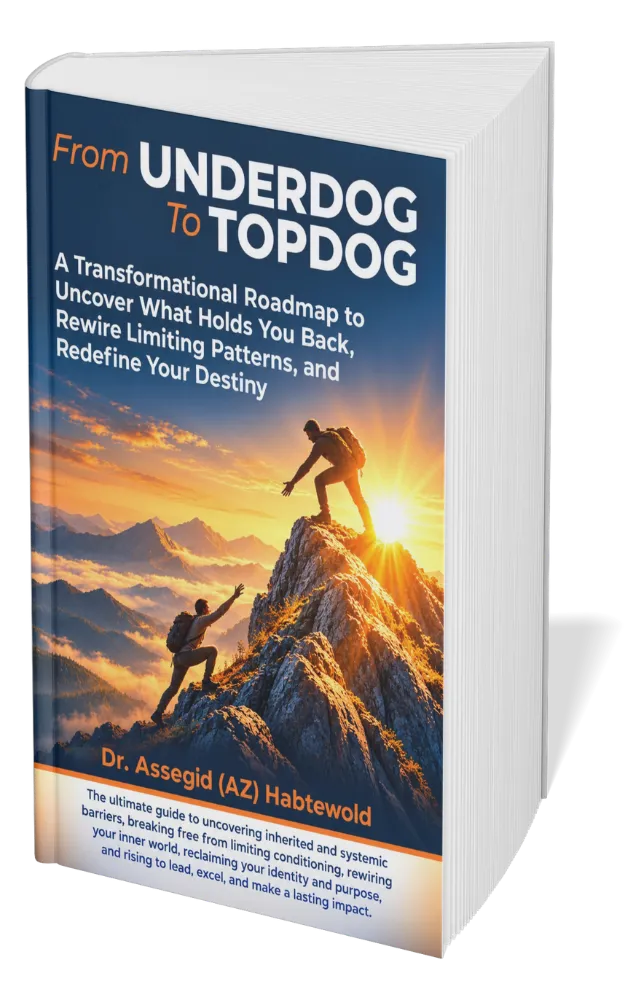
From Underdog To Topdog (Sample)
Introduction
Why So Many Stay Underdogs
"The first and best victory is to conquer self." Plato, Philosopher
Uncover the forces that shaped the underdog within. Rewire the patterns that keep the past alive. Redefine your destiny and become who you were created to become.
Across nations, cultures, races, and generations, humanity has wrestled with the plight of the underdog. Governments create programs for disadvantaged communities, advocacy organizations confront discrimination and exclusion, and movements educate, organize, litigate, and demand reform. These efforts matter. Systemic barriers and unequal starting points are real, and societies have a responsibility to make institutions more just and opportunities more accessible.
Yet billions of underdogs still live and die far beneath their potential. I believe one reason is that we’ve concentrated on what stands in front of the underdog while neglecting what disadvantage may leave within:
1. We challenge discrimination without always confronting internalized inferiority.
2. We expand opportunities without expanding the imagination and confidence required to pursue them.
3. We confront oppressive systems while overlooking the conditioning that keeps enforcing yesterday’s limitations from within.
From Underdog to Topdog addresses this neglected challenge without dismissing the need for systemic reform. Both must advance together. While underdogs may have limited power to change entrenched systems, they can reclaim control over their lives, overcome internal limitations, and develop the capacity to challenge external barriers.
This book's higher mandate is to empower underdogs to break free from inherited limitations, unlock their potential, rise to the top in their chosen fields, and use their growing influence to transform lives, institutions, and communities.
The Missing Battle in the Underdog Struggle
Research across psychology, neuroscience, human development, and epigenetics continues to show how biology, environment, experience, and behavior interact. Some influences begin before we can choose anything; others accumulate through family, culture, adversity, and repeated experience. Yet influence is not destiny. Human beings also possess remarkable capacities to learn, adapt, and change.
Psychologists Martin Seligman and Steven Maier conducted experiments that helped develop the concept of learned helplessness. Animals exposed to uncontrollable unpleasant experiences sometimes failed to escape when escape later became possible. Animal experiments cannot explain human disadvantage, but they offer an instructive insight: repeated powerlessness can shape our responses even after circumstances change.
1. The cage may open while an old expectation still says, Don’t move.
2. Opportunity may appear while an inherited belief whispers, People like us don’t belong there.
3. A door may open while fear or learned passivity prevents someone from walking through it.
What happens when the barrier outside acquires a voice inside? I did not arrive at that question through research alone. I lived it.
I Know the Underdog Journey
I was born in one of Ethiopia’s poorest villages, surrounded by scarcity and limited exposure, yet I never thought of myself as disadvantaged. My environment simply felt normal. That is one of conditioning’s greatest powers: when something surrounds us long enough, we mistake what is familiar for what is inevitable. My world expanded step by step:
-Education opened possibilities I had never considered.
-Leadership widened my sense of what I could become, from youth leader to President of the Addis Ababa University Students’ Union.
-Immigrating to the United States opened further doors as I built a life as an author, coach, trainer, consultant, Advisor, entrepreneur, and leader developer.
But crossing physical borders did not erase psychological ones. Geography didn’t change every belief, education didn’t remove every insecurity, and achievement didn’t silence every earlier message. Some boundaries traveled with me. These experiences clarified the purpose that organizes my life: restoring humanity’s greatness, one person at a time. What better place to advance it than among people whose potential has been underestimated, marginalized, or conditioned downward?
I also learned that wanting to rise and being prepared to rise are different things. Someone can:
1. Pursue a topdog career while carrying underdog expectations,
2. Receive an extraordinary opportunity while doubting they deserve it, or
3. Hold a leadership position while still waiting for permission to lead.
That is why this book goes beneath motivation to examine what shapes our sense of possibility.
The Four Barriers Beneath the Surface
Traditionally, an underdog is someone expected to lose. I use the term more broadly for people seeking to advance while carrying meaningful disadvantages: poverty, race, ethnicity, gender, disability, immigration status, social class, geography, family background, discrimination, or limited access to education, capital, networks, and opportunity. But underdog status can migrate inward. You can leave poverty while still thinking from scarcity or become educated while questioning whether you belong in certain rooms. Those who underestimated you may disappear while their voices remain.
This book examines four layers of influence: predispositions and prenatal influences, family psyche, cultural conditioning, and systemic barriers. Together they shape what we consider normal, possible, safe, worthy, or beyond reach. The aim is not to blame our genes, parents, cultures, or governments, but to understand these influences and respond constructively:
a. Individuals can challenge what they have internalized.
b. Families and communities can reconsider what they transmit.
c. Institutions can remove barriers while developing people’s capacity to use opportunities.
d. Nations can cultivate citizens equipped to create, innovate, lead, and prosper.
What Becoming a Topdog Really Means
By topdog, I do not mean becoming wealthier, more famous, or more powerful than everyone else, and certainly not escaping oppression only to become someone else’s oppressor. Topdog is not about superiority or domination. It is a metaphor for becoming increasingly capable of expressing your potential, uniqueness, purpose, and greatness, reaching the height appropriate to your assignment rather than measuring yourself against someone else’s. It means refusing to remain permanently beneath your potential, fulfilling your purpose, and using your growing influence to help others rise.
I see human beings as more than flesh, blood, biography, or social category. We are conscious beings with agency and, from my spiritual worldview, children of God carrying assignments larger than survival. Our bodies and minds may inherit limitations and absorb conditioning, but those influences need not dictate our future.
The Underdog-to-Topdog Transformation Framework™
Our journey follows three stages: Uncover → Rewire → Redefine
1. Uncover develops self-awareness by examining what shaped the underdog within: predispositions, family psyche, cultural conditioning, and systemic barriers.
2. Rewire develops self-management by addressing the beliefs, thoughts, imagination, words, emotions, habits, and actions through which old conditioning keeps operating.
3. Redefine advances toward self-mastery and destiny-shaping by reclaiming identity and purpose, envisioning a greater future, establishing empowering values, and developing the leadership to turn potential into contribution, impact, and legacy.
The sequence may not be perfectly linear: a new opportunity may expose an old fear, and a larger vision may reveal another belief needing attention. Return to the framework whenever the journey demands it.
A Roadmap for Underdogs and Those Who Empower Them
This book is for:
-The village child who cannot yet imagine the rooms they may someday enter,
-The minority professional who lowers expectations before others do,
-The immigrant carrying old limitations into new opportunities, the first-generation student navigating unfamiliar territory, and anyone who has spent too long interpreting disadvantage as destiny.
It is also equally for parents, educators, churches, universities, employers, community organizations, advocates, governments, and institutions committed to developing human potential.
Empowerment can’t end with explaining injustice, providing assistance, and expanding access. We must also help people challenge inherited ceilings, recognize opportunities, build productive habits, discover purpose, create value, and lead. When we reform the conditions surrounding underdogs while strengthening their capacity from within, personal transformation can become a movement that benefits families, organizations, communities, and nations.
Your Starting Point Is Not Your Sentence
You did not choose:
1. Where you were born,
2. Your DNA,
3. The family awaiting you,
4. The culture that first shaped your expectations, or every system you would navigate.
Some of those influences equipped you with valuable strengths; others imposed disadvantages you may still be overcoming.
Understand the barriers outside you and help change those that deserve reform. Participate, organize, advocate, and support worthy movements. But do not surrender your future while waiting for every external obstacle to disappear:
a. Uncover what shaped the underdog within.
b. Rewire what keeps the past alive.
c. Redefine who you will become and what you will contribute.
My hope is that one day you will look back toward the valley you climbed out of, not with contempt for those still there, but with enough strength, wisdom, and influence to extend your hand.
The world faces challenges too great to leave so much human potential unrealized. It needs underdogs who rise in their professions, industries, and communities, then use their capabilities to create opportunities and solve problems that matter.
You inherited a starting point, not a final destination.
Let us begin.
PART I: The Hidden Forces That Shape Underdogs
(Uncover Before You Rewire)
“Not everything that is faced can be changed; but nothing can be changed until it is faced.” James Baldwin, Writer and Civil Rights Activist
Uncover what has shaped you beneath the surface. Separate conditioning from identity. Reclaim agency over your future.
Let me begin with a house. Imagine buying an old house with enormous potential. You repaint the walls, replace the flooring, and remodel the kitchen. Then the cracks return. A door stops closing. The floor begins shifting. Eventually, an expert tells you the problem was underneath everything you renovated: the foundation had been compromised.
Human transformation can work the same way. We work on what we can see: another degree, a better job, more money, a coach, a promise to work harder. Yet capable people sometimes discover that old patterns followed them.
a. The job changes, but the insecurity remains.
b. Income increases, but scarcity thinking survives.
c. Qualifications improve, but self-doubt persists.
Just as lasting renovation requires understanding what is happening beneath a house, lasting personal transformation requires examining the forces beneath our beliefs, expectations, and behaviors. Before we can effectively rewire what limits us, we must uncover what shaped us. That is why the Underdog-to-Topdog Transformation Framework™ begins with Uncover, not Rewire.
Part I examines four forces that may have shaped our underdog starting point:
1. Pre-birth inheritances,
2. Family psyche,
3. Cultural conditioning, and
4. Systemic barriers.
I call them archenemies not because biology, families, cultures, or institutions are inherently hostile, but because the limiting patterns they transmit can keep working against our potential long after we forget where they started.
You Cannot Rewire What You Cannot See
A physician does not begin treatment by guessing. She studies symptoms and searches for underlying causes.
-Before asking, How can I become more confident? ask, What trained me to doubt myself?
-Before asking, How can I think bigger? investigate where you learned to think small.
Hidden conditioning can masquerade as personality, virtue, or fate. We call something:
1. Prudence when it is partly fear,
2. Loyalty when it is an unexamined family expectation,
3. Humility when it is actually a diminished sense of our own potential, and
4. Impossible when we have never tested the limitation.
Some underdogs mistake thinking small, dreaming small, speaking timidly, and avoiding bold action for being humble. They may even judge fellow underdogs who dare to envision extraordinary futures as arrogant, egotistical, naive, unrealistic, or outright crazy. Yet humility does not require us to underestimate our potential, suppress our ambitions, or apologize for aspiring to greatness. We can recognize our capabilities, pursue extraordinary goals, and remain genuinely humble in how we treat others.
I wish I had understood this earlier. Growing up in my hometown, Harar, I was surrounded by scarcity, caution, and assumptions about what was realistic. Education, leadership, and immigration to the United States expanded my world, but changing geography did not automatically change psychology.
Some borders traveled with me. I could envision where I wanted to go while unconscious beliefs and habits kept operating from somewhere else. So, I began investigating my own formation:
a. Revisiting how I was raised,
b. Talking with fellow underdogs, and
c. Studying people who had risen from disadvantaged beginnings.
I still periodically ask what blind spot may be lowering my bar or sabotaging my next level. Uncovering is not an event. It is a lifelong discipline.
Four Layers Beneath the Underdog
When society asks why people become and remain underdogs, attention moves to the most visible layer: the system, meaning discrimination, poverty, unequal education, and restricted access. Those barriers are real.
The problem is not that we examine them too much, but that we examine the other three too little. Before most people encounter governments, corporations, or marketplaces, other forces have already shaped them: influences before birth, then family, then culture and subculture. That is why Part I moves from the deepest and least visible influences outward:
Chapter 1: Predisposed Before Birth, examines the earliest influences and establishes that predisposition is not predestination.
Chapter 2: The Family Psyche, investigates beliefs and expectations absorbed in our first social environment.
Chapter 3: Cultural Conditioning, explores the wider codes that teach us what people like us should attempt or avoid.
Chapter 4: Systemic Barriers, confronts structures that restrict opportunity and may require collective action and reform.
These layers interact, so an underdog may meet the system already carrying assumptions about belonging, authority, risk, visibility, wealth, and leadership. Empowerment cannot begin and end with changing the system.
The Barriers Closest to Us
Many underdogs readily acknowledge systemic barriers, but examining family psyche and cultural conditioning can trigger defensiveness.
Unlike external systems, family and culture feel inseparable from our identity. They provide language, belonging, faith, resilience, and traditions worth preserving. Uncovering their influence does not mean rejecting them. It means separating what strengthens us from what limits us, and genuine loyalty from blind loyalty. A survival strategy that protected previous generations may now discourage their descendants from pursuing opportunities those generations never imagined.
The challenge is that these influences rarely operate in isolation. An underdog may confront one barrier while remaining unaware of others that continue limiting their choices. Consider these examples:
1. A woman may challenge workplace discrimination while never questioning a family expectation that discourages her from becoming too visible or ambitious.
2. An immigrant may enter a society with greater opportunities while still making decisions shaped by inherited scarcity and cultural expectations.
3. A first-generation professional may earn impressive credentials while still carrying the belief, People like us do not belong here.
Overcoming one barrier matters, but lasting transformation requires recognizing how other layers may still influence us. Equally important, personal responsibility must never excuse ignoring injustice. Uncover is about seeing the whole picture, both our limitations and the forces around us.
Our ability to change these influences varies. We cannot choose our family or reverse what happened before birth. But we can examine inherited patterns, question cultural expectations, and choose new influences. Systemic barriers may require advocacy, voting, coalitions, and policy reform.
However, we need not postpone personal transformation until every unjust system disappears. We can act on what we can control while contributing to changes that require collective effort. As our capacity and influence grow, so does our ability to help transform the larger systems.
Influence Is Not Destiny
Carry one principle through Part I: influence is not destiny. Identifying limiting family programming does not make your parents villains, and questioning cultural conditioning does not require abandoning your heritage. The purpose of diagnosis is not blame. It is choice.
My ancestors, family, and culture passed strengths to me that I remain grateful for, along with assumptions shaped by different circumstances. A family shaped by scarcity may teach extreme caution because caution once protected it. A marginalized community may discourage visibility because visibility once carried danger. Parents who suffered disappointment may discourage risk to protect their children. The intention is protection; the unintended consequence is limitation.
Something you call personality may partly be conditioning:
-I am not a risk-taker.
-I don’t belong in leadership.
-People like us don’t become wealthy.
Before making such conclusive statements permanent,
1. Ask where they came from,
2. What reinforced them, and
3. Whether they still deserve authority over the person you are becoming.
Instead of declaring, This is who I am, ask, What if this is simply what I was conditioned to believe about myself, long before I was aware of it or had the opportunity to question it? Awareness does not erase the past, but it prevents the past from continuing to shape your life unconsciously and without your permission.
Before You Rewire, Investigate the Wiring
Become an investigator of your own formation. Notice what you inherited, absorbed, and internalized, especially the influences you instinctively defend. Do not use what you uncover as evidence for why you must remain an underdog. Use it to identify what must no longer operate without your awareness or consent. Part I asks: What forces shaped my starting point, beliefs, and limitations? Part II asks: How can I rewire the beliefs, thoughts, emotions, and habits that continue to hold me back?
Our investigation begins with the earliest and least visible influences: those that may have shaped you before you were even born.
Chapter 1: Predisposed Before Birth
(Uncover the Invisible Influences That May Have Shaped Your Starting Point)
“Development is plastic. One genotype can give rise to different physiological or morphological states in response to different environmental conditions during development.” David J. P. Barker, Physician and Epidemiologist
Look beneath the story you remember. Discover what may have shaped your starting point before birth. Separate predisposition from identity. Prepare to rewire what no longer serves your future.
Most people begin the story of who they are too late. Ask why someone struggles with fear, scarcity, excessive caution, or difficulty taking risks, and the investigation usually begins with childhood: parents, schooling, poverty, discrimination, or culture. Those forces matter enormously, and the next three chapters examine them. But what if part of your story began before you could recognize your parents or consciously form beliefs?
When I began studying underdogs, I focused on visible barriers: poverty, education, family, culture, discrimination, and political and economic systems. But a deeper exploration of human development raised another question: What if some influences begin before we enter the world?
We speak of birth as if someone presses a biological START button in the delivery room. Yet the developing brain has already been responding to signals from the womb. Through prenatal development and epigenetic processes, early environments can influence how certain biological systems develop and respond.
This early conditioning is not necessarily a disadvantage. Some prenatal adaptations may help prepare a child for the environment into which they will be born. But conditions change, and responses that were once protective may become limiting later in life. What helped prepare you for survival may not always prepare you for success. Understanding these influences helps us recognize possible predispositions without mistaking them for permanent limitations.
You did not arrive biologically empty, nor was your destiny already written. You arrived with a starting point. The first task of Uncover is to examine it without turning it into an excuse, diagnosis, or sentence.
1.1 What May Have Predisposed You Before Birth
Most of us learned that parents pass DNA to their children and that genes influence physical characteristics. That remains true, but epigenetics adds another layer.
The Library and the Librarian
Think of your DNA as a library filled with thousands of books. Not every book is opened or read. Your DNA carries the instructions, while epigenetic processes act like a librarian, helping determine which instructions are used and which remain quiet. They can influence how your genes work without changing the DNA itself. Scientists are also exploring whether certain human experiences can leave biological marks that influence future generations.
When an Experience Appeared in the Next Generation
Neuroscientists Brian Dias and Kerry Ressler conditioned adult male mice to associate the odor acetophenone with mild foot shocks, making them unusually sensitive to the smell. Researchers bred the males with unconditioned females, minimizing direct social transmission. Their offspring never received the shocks, yet showed increased sensitivity to the same odor, and the next generation did too. Researchers also reported changes in the relevant olfactory pathway and methylation of the corresponding odor-receptor gene in sperm.
We must not exaggerate. The mice did not inherit a narrated memory, and mice are not miniature humans. Human development involves parenting, language, culture, economics, and countless other influences, and transgenerational epigenetic inheritance in humans remains debated. The responsible lesson is narrower but powerful: we should not assume that everything influencing our biological starting point began with us.
“You Are Just Like Your Grandfather”
Families noticed recurring patterns long before the word epigenetics.
· “You have your grandfather’s temper.”
· “She worries exactly like her mother.”
· “Addiction runs in our family.”
· “He has his father’s nerves.”
Such observations aren't scientific proof. Similarities can arise from DNA, modeling, parenting, shared culture, prenatal influences, or economic conditions. Uncover does not diagnose the mechanism. It becomes curious about patterns we may have mistaken for permanent identity. Instead of asking, What is wrong with me? ask: What seems to repeat across generations in my family, and how might it still be expressing itself through me? Sometimes freedom begins with a better question.
1.2 Why Prewiring Can Matter
Whatever science establishes about transgenerational inheritance, one fact is clear: your brain began developing before birth. I call this prewiring. A fetus cannot consciously understand danger, scarcity, or fear. Yet inherited genetic factors, epigenetic processes, and biological signals from the mother's environment influence its developing brain. Together, these influences shape early brain development and stress responses before the child is born.
Epigenetic processes help regulate gene activity during development without changing the DNA itself. Together with other prenatal influences, they may shape a newborn's temperament, stress sensitivity, and emotional responses. Your psychological starting point may begin forming before your first breath, but it does not determine your destiny.
Prewiring can give us a valuable head start. Biological signals influenced partly by the mother's environment may help prepare a developing child for life after birth. However, early adaptations that support survival may become limiting when circumstances change. What once helped us survive may eventually hold us back from thriving. Recognizing these tendencies is the first step toward questioning and, where necessary, rewiring them.
The Computer Was New, but Not Empty
Imagine opening a brand-new computer. Although new to you, it already has an operating system and basic settings. You did not install them, but they influence how the computer operates. Human development is far more complex, yet the principle remains: new does not mean blank.
Likewise, we may carry tendencies we never consciously chose. Consider three questions:
· Why am I unusually sensitive to threats?
· Why do I protect what I have rather than explore new opportunities?
· Why do I hesitate to take risks even when circumstances favor me?
Prenatal development cannot fully explain these tendencies, but we shouldn't assume their origins lie entirely in childhood experiences we can remember.
What Protected You May Not Propel You
Research on developmental plasticity and fetal programming explores how early conditions influence development. In environments marked by scarcity or danger, heightened sensitivity to threats and stress may offer protective advantages. The difficulty arises when those early responses persist in different circumstances.
Someone shaped by scarcity may later face opportunities that require confidence, experimentation, visibility, and calculated risks. Yet old tendencies may discourage the very actions needed to advance. This creates an important distinction:
· Then: Caution, vigilance, and conserving resources may have supported survival.
· Now: Excessive caution, distrust, and fear of failure may restrict opportunities.
· Next: Awareness lets us examine these tendencies, keep what serves us, and work to change what holds us back.
Do not despise the tendencies that may once have protected you or those before you. But do not allow survival strategies to become your permanent ceiling.
1.3 How the Earliest Environment May Express Itself
The womb was our first environment. Although protected, we were not isolated from our mother's physical condition, including her nutrition, illness, stress, and exposure to harmful substances. These conditions can influence early brain and body development, but they do not permanently determine who we become or what we can achieve.
When History Entered the Womb
During the Dutch Hunger Winter of 1944–1945, severe famine struck the western Netherlands, affecting thousands of pregnant women.
Because researchers could document the famine and its victims, they could later study people exposed to these conditions before birth. One influential study found differences in DNA methylation of the IGF2 gene between people exposed around conception and their unexposed same-sex siblings, nearly six decades later.
The study did not prove that famine determined their personalities or futures. It revealed something remarkable: conditions during early development can leave biological traces detectable decades later.
What Was Happening Around Your Mother?
This research led me to ask questions I had never considered about my own beginnings:
· What was happening in my mother's life while she carried me?
· Did she have enough food and other necessities?
· Was she living in safety or uncertainty?
· Did she feel loved, supported, and cared for?
· What pressures or hardships might she have faced?
I grew up in Ethiopia, where poverty, political uncertainty, conflict, and food insecurity have affected generations. My mother was not my father's first wife, and he passed away while I was in high school. Looking back, I can’t fully judge their relationship, but I remember him as someone who rarely showed her affection or care. I also recognize that my mother's income was limited. These circumstances make me wonder whether she experienced stress, insecurity, or scarcity while carrying me. I can’t know for certain, but the questions are worth asking.
I can’t trace a particular behavior in myself to a specific prenatal experience, and neither should you. We are not diagnosing ourselves through speculation. We are learning to examine our beginnings with curiosity rather than judgment.
A fetus cannot understand war, unemployment, fear, poverty, or discrimination, but the developing body can respond to biological signals associated with stress. Researchers study how maternal stress, hormones, inflammation, and placental function may influence development.
Consider two pregnancies:
· One unfolds amid adequate nutrition, safety, affection, care, and family support.
· The other unfolds amid violence, displacement, stress, severe poverty, or persistent fear.
These children may experience very different prenatal conditions. Yet we can’t conclude that the second child is destined for anxiety, insecurity, or underdog status. Genetics, timing, relationships, later environments, learning, and personal choices also shape development.
Influence is not destiny.
1.4 Predisposed, Not Predestined
Everything here could be misread: My ancestors suffered. My mother experienced stress. Apparently, I was destined to become an underdog.
No. A predisposition may influence probability, but it does not determine destiny. After birth, family, peers, schools, communities, cultures, and systems continue shaping us. Meanwhile, the brain retains remarkable capacities for learning and change throughout life. That is why this chapter belongs in Uncover, not Accept Your Fate. We uncover what shaped us so we can rewire what limits us.
Stop Calling Every Pattern “Me”
Perhaps you have said, I'm just an anxious person. I'm naturally afraid of risk. I've always needed certainty. That's simply who I am. Be careful what you repeatedly declare about yourself. Every I am statement can reinforce an identity, shaping what you believe is possible and how you behave. When repeated often enough, a limiting description can become a self-fulfilling prophecy. These statements may describe recurring patterns, but patterns are not identities. Genetics, prenatal conditions, family conditioning, culture, and experience may all contribute. Stop confusing something you carry with the totality of who you are.
You had no vote in your ancestry, DNA, or earliest brain development. But eventually, something changed: you became conscious. You gained knowledge, discovered alternatives, and developed the ability to choose. As awareness grows, so does responsibility. You may not be responsible for your initial wiring, but you increasingly become responsible for what you do once you recognize its influence.
From Survival Wiring to Success Wiring
Honor what helped previous generations survive without allowing those survival strategies to limit your future:
· Extreme vigilance protects in danger but exhausts in safety.
· Excessive caution reduces losses but prevents calculated risks.
· Distrust guards against exploitation but obstructs collaboration.
· Keeping your head down protects in hostile environments but can hinder leadership and influence.
The question shifts from Why am I like this? to Does this pattern still serve where I am going? I call these inherited and conditioned patterns the Underdog Code because some developed before we could consciously choose them. But something inherited does not have to remain unchanged. Some patterns can be rewired, others redirected, and some transformed into extraordinary strengths. Part II explains how. First, we must uncover three more layers. For now, practice awareness without blame and responsibility without denial.
Reflect and Practice
Reflect
· What pattern seems to repeat across generations in my family?
· What do I know about the conditions surrounding my earliest development?
· What pattern have I mistaken for my identity?
Practice
Conduct a One-Pattern Audit. Choose one recurring family pattern, limiting or empowering. Explore what you know about its possible origins and how it influences your life today. Avoid diagnosing its cause. Simply ask: Does this pattern deserve to continue through me?
From the Womb to the Home
We began with the earliest, least visible influences, those that shaped us before memory and conscious choice. But birth introduces another powerful environment: the home. Here, our developing minds encounter the voices, behaviors, beliefs, expectations, and unwritten rules of those closest to us. Some nurture our potential; others quietly establish limitations we may carry for decades.
Chapter 1 explored how influences before birth may shape our starting point. Chapter 2 takes us into the home, where our family's words, beliefs, behaviors, and expectations begin shaping how we see ourselves, others, and the world around us.
Next Steps & Resources
👉 Check out the Table of Contents of the book here...

© 2026: The A to Z Institute, LLC All Rights Reserved