



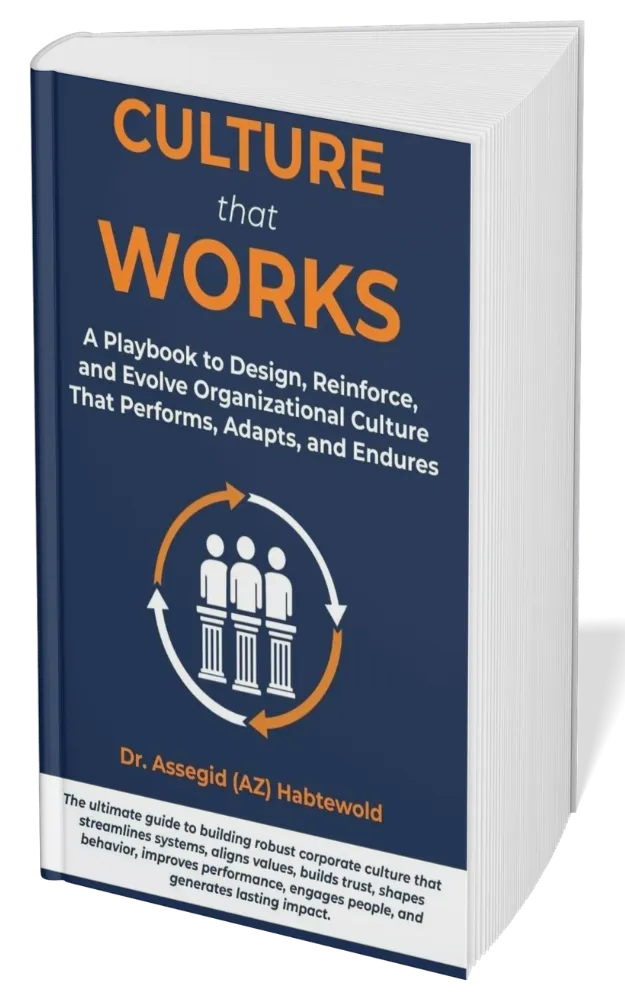
Culture That Works (Sample)
Introduction: Why Culture Is the Real Operating System
“Culture eats strategy for breakfast.” Peter Drucker, Management and Culture Consultant
I learned the power of culture long before I ever studied it. I grew up in the eastern part of Ethiopia, Harar, which is 515 KM away from the capital city Addis Ababa. In Harar hierarchy was light, relationships were informal, and communication was open and communal. People spoke freely and liberally. Time was flexible. Boundaries were relational, not rigid.
When I later moved to Addis Ababa, the capital city, I experienced my first real culture shock. Same country. Same people. Same language. Completely different operating code. More formality. Clearer hierarchy. Stronger individualism. Unspoken rules I had never needed to navigate before.
That was only the beginning.
As President of the Addis Ababa University Students’ Union in the late 1990s, I traveled across several African countries. What struck me was not the diversity itself, but how normal behavior in one country within the continent could be inappropriate—or even offensive—in another. Communication styles, attitudes toward authority, and ways of resolving conflict varied widely.
At the time, I was confused. I had been thinking that all people in Africa communicate, behave, and act the same. As a result, I was judgmental. I kept asking: Why do they say this? Why do they behave and act that way? Only later did I realize they were asking the same questions about me. Then came the most jarring transition of all: relocating from Ethiopia to the United States.
If moving from my hometown to the capital felt like a moderate shock, and traveling across Africa felt intense, coming to the U.S. was seismic. Communication styles, attitudes toward time, authority, personal boundaries, feedback, and accountability were not just different. They were often the opposite of what I had known.
And the pattern didn’t stop there.
Each time I entered a new corporate environment, I felt like an outsider again. Different industries. Different leadership styles. Different unspoken rules. Same result: until I understood the culture, communicating, getting along, building relationships, generating trust, and making progress was harder and slower.
When Culture Becomes Visible
Those experiences forced a realization I could no longer ignore. Culture dictates mindset, behavior, decision, and action long before strategy ever has a chance.
Before that realization, I treated culture as background noise—important, perhaps, but secondary to strategy, plans, goals, and execution. After those experiences, I began to see culture for what it really is: the core operating system without which everything else struggles to function.
That realization reshaped my work.
I began studying societal and organizational cultures deliberately. I developed cultural intelligence to cross boundaries without committing invisible but costly cultural errors. My work expanded to coaching leaders navigating diverse teams and advising organizations on how to design, strengthen, and reform their cultures.
Across borders and boardrooms, the same pattern kept repeating: When culture was misaligned, performance suffered—even with talented people and solid plans.
That insight changed how I lead, how I coach, and how I train. This book is drawn from that journey—personal experience, applied work with leaders and organizations, and decades of observing culture’s quiet but decisive influence and impact.
What Most Leaders Miss About Culture
I am not alone in this realization.
For decades, scholars and practitioners have observed that culture operates beneath awareness, shaping behavior long before people consciously choose how to act. Edgar Schein, business theorist and psychologist, later gave language to what many of us had experienced firsthand—describing culture as a system of shared assumptions learned over time, often invisible to those living inside it.
Yet most leaders still believe they are running on strategy, structure, and systems. They are not. They are running on culture.
Culture is not what hangs on the wall.
· It is what happens in meetings when pressure rises.
· It is how decisions are made when no one is watching.
· It is what gets rewarded, tolerated, ignored, or quietly punished.
Culture Is the Real Operating System
Culture is the invisible operating system running in the background of every nation, organization, team, family, and movement.
Think of hardware, software, and applications. None of them function without an operating system. None of them optimize performance without it. None of them operate independently of it.
Culture works the same way.
And like any operating system, when it is outdated, corrupted, or poorly designed:
1. Strategies stall.
2. Systems get bypassed.
3. Good people disengage.
4. Harmony and synergy weaken.
5. Performance suffers.
6. Productivity declines.
Not because they lack talent, intent, or dedication—but because the culture beneath everything else is quietly working against them.
When Strategy Fails, Culture Is Usually the Reason
I once worked with a leadership team that had just completed an expensive strategic planning retreat. The vision was clear. The goals were ambitious. The plan looked solid on paper. Six months later, almost nothing had changed. Execution stalled. Accountability weakened. Meetings felt heavy. Decisions were delayed, diluted, or reversed. Frustration grew.
They invited us to audit their strategic plan and its execution using our Strategic Edge framework. When we stepped back and looked honestly, the problem was not the plan. The problem was the culture. The culture was risk averse. Risk-taking was quietly discouraged. People avoided hard conversations. Ownership was unclear. The organization rewarded harmony over truth and activity over results.
The strategy didn’t fail. The culture rejected it.
This pattern repeats more often than leaders want to admit.
· We try to fix performance with new plans.
· We try to fix engagement with perks.
· We try to fix execution with tools and dashboards.
But culture keeps pulling everything back to its default settings.
Culture Is Always Being Created—With or Without You
One of the most dangerous myths about culture is that it is soft, secondary, or something to address later. The truth is simpler—and less forgiving:
1. Culture is never neutral.
2. Culture is never optional.
3. Culture is never static.
Every decision you make, every behavior you reward, every standard you tolerate is shaping culture in real time.
I have seen organizations with no formal values statement but very strong cultures—because behaviors were consistent and expectations were clear. I have also seen organizations with beautifully written values, maybe copied from somewhere, that meant nothing—because daily actions contradicted every word.
Culture does not respond to intention. Culture responds to consistency.
Why Most Change Efforts Fail
Most change initiatives fail not because the ideas are wrong or the people are incapable.
Research consistently shows that roughly 60–70% of major change initiatives fail, and culture is one of the most cited reasons.
Either existing cultural norms actively sabotage the change, or the organization lacks cultural support to sustain it.
Change asks people to behave differently. Culture decides whether that behavior is safe, rewarded, or punished. When culture and change are misaligned, culture always wins.
Why Changing at the Top Alone Is Not Enough
Organizations that achieve real transformation understand a hard truth: culture cannot be changed through titles alone.
That is why many serious transformations involve bringing in leaders from outside the existing system—leaders without emotional attachment to legacy norms. These leaders are explicitly authorized to challenge assumptions, reset standards, and make difficult decisions, including removing those unwilling or unable to support the new direction.
Transformation requires permission to disrupt the old operating system—not just manage it.
Why This Book Exists
This book exists because too many leaders inherit culture by accident instead of designing it on purpose. It exists because culture conversations are often vague, emotional, or theoretical—when they should be practical, observable, and actionable. And it exists because culture is not about being nice or creating a pleasant workplace.
Culture determines:
· Who gets hired, promoted, and trusted
· How communication is conducted
· How fast decisions are made
· How conflict is handled
· How well teams collaborate under pressure
· How execution holds up during growth or crisis
· Whether performance is sustainable or fragile
Culture determines whether organizations scale—or stall.
What This Book Will Do for You
This is not a motivational book about values. And it is not an academic text filled with theory. This is a practical guide to help you:
1. Decode culture — so you can see what is really shaping behavior
2. Design culture intentionally — by translating values into systems and daily practices
3. Deploy culture consistently — so it shows up where it matters most
4. Dismantle and evolve culture — when growth, disruption, or crisis demands it
At the center of this book is The Cultural Architecture and Renewal Framework — a disciplined model for understanding how culture is formed, reinforced, misaligned, repaired, and redesigned for the future. It moves culture from sentiment to structure, from slogans to systems, and from intention to institutional durability.
Throughout the book, you will find:
· Stories from my leadership journey
· Real examples from organizations and leaders
· Clear frameworks you can apply immediately
· Practical tools to assess, design, and strengthen culture
· Guidance on how to form, reform, or evolve culture responsibly
You do not need permission to begin.
You do not need a title to apply what you learn.
You do not need perfect conditions to start.
You only need the willingness to look honestly — and lead deliberately.
Culture Is Your Legacy
Long after strategies change, org charts shift, and technologies evolve, one thing remains.
Culture.
· Culture is what people remember and obey.
· Culture is what gets passed on and inherited.
· Culture is what outlives any single leader or team.
The question is not whether you are shaping culture. You already are. The real question is whether you will do it intentionally and proactive.
Let’s begin.
PART I: Decode Culture
“Culture hides more than it reveals, and strangely enough, what it hides, it hides most effectively from its own participants.” Edward T. Hall, Anthropologist and Culture Expert
Observe the invisible. Interpret signals. Understand what shapes behavior.
people experience culture without ever truly seeing it. They feel its effects but rarely question its source. They’re blind loyal, adapt to it, but seldom name it. They inhabit in it, operate within it, but almost never design it. That is what makes culture so powerful—and so dangerous when left unexamined.
Culture does not announce itself. It isn’t noisy. It doesn’t brag. It does not introduce itself in meetings or appear in reports. It reveals itself quietly, through patterns: how people speak to one another, how conflict is handled, how time is treated, how decisions are made, and how accountability shows up under pressure.
Edgar and Peter Schein, father and son cultural experts, describe culture as a pattern of shared assumptions learned over time as groups solve problems and adapt to their environment. These assumptions become taken for granted — so embedded that people rarely question them. This explains why culture often feels invisible to insiders and why behavior remains consistent even when values statements or strategies change.
Cultural theorist Terry Eagleton cautions against treating culture as a neutral or purely technical concept. He argues that culture has always carried tension — between refinement and control, identity and power, belonging and exclusion. Culture is not merely what groups share; it is also what they contest, protect, and enforce over time. This helps explain why culture resists simple definition and why attempts to reduce it to slogans or programs often fail. Culture is lived meaning, shaped by history, values, and conflict — not something leaders install, but something they inherit, influence, and must learn to read carefully.
I have watched leaders struggle not because they lacked intelligence, talent, authority, or effort—but because they were trying to solve visible problems without understanding the invisible forces beneath them. They addressed symptoms, not systems.
Edgar Schein later addressed this exact issue and explained why culture so often resists change even when leaders are well-intentioned. Culture is not stubborn by accident; it protects shared assumptions that once ensured success or survival. When leaders attempt to change behavior without understanding what those behaviors are protecting, culture responds defensively — preserving the system even as results deteriorate.
Culture Is Experienced Before It Is Understood
When someone joins a new organization, they quickly sense what is acceptable and what is not—often before anyone explains it. They notice who speaks and who stays quiet. They observe which behaviors get rewarded and which ones carry consequences. They learn what “success” really means, regardless of what the values statement says.
This learning does not happen through orientation manuals. It happens through observation, repetition, and subtle social cues.
That is why culture is so effective at shaping behavior. It teaches without lecturing. It disciplines without formal authority. It directs action long before strategy has time to intervene.
Why Leaders Misread Culture
One of the most common leadership mistakes I see is assuming that culture is obvious. It is not. Culture is clearest to outsiders and most invisible to insiders. The longer you operate inside a system, the more its assumptions feel normal, natural, and unquestionable. What once felt strange becomes familiar. What once stood out fades into the background.
This is why leaders often struggle to diagnose cultural issues within their own teams. They are too close to it. They are inside the system they are trying to understand. Decoding culture requires self-awareness, distance, curiosity, and discipline. It requires leaders to slow down, observe patterns, connect dots, and question what they have taken for granted.
What This Part Will Help You See
This Part focuses on the Design phase of The Cultural Architecture and Renewal Framework. Part I is about developing the ability to see culture clearly before attempting to shape it. In the chapters that follow, you will learn how to:
· Understand what culture truly is—and what it is not
· Identify the pillars, signals, and reinforcers that sustain it
· Recognize how culture shapes mindset, behavior, and character
· See how culture influences growth, ambition, and progress
You will also begin to notice culture differently—not just in organizations, but in teams, families, communities, and even within yourself. This is not about labeling cultures as good or bad. It is about seeing them accurately. Because once culture becomes visible, it becomes workable. And that is where intentional leadership begins.
Chapter 1: Understand Culture
“Culture is the pattern of shared assumptions learned by a group as it solves its problems.” Edgar Schein, Psychologist and Professor
Define culture clearly. Move beyond slogans. See how meaning becomes behavior.
Before leaders can shape culture, they must first see it clearly. Most cultural failures do not come from bad intentions or lack of values. They come from misunderstanding what culture actually is, how it forms, and how powerfully it governs behavior long before strategy or structure enter the picture.
This chapter lays the foundation for the framework. Not to inspire action yet — but to sharpen awareness.
Most people think they understand culture. They associate it with values statements, perks, traditions, or the general “feel” of an organization. Some see it as something in the background and soft. Others treat it as something abstract. Many leaders assume culture is simply a byproduct of hiring good people and setting clear goals.
It is none of those things.
· Culture is not a slogan.
· Culture is not a personality.
· Culture is not what leaders say they want.
Culture is what a group learns, assumes, and repeats as it navigates reality together.
Ritz-Carlton famously teaches culture not as customer service, but as identity. Every employee is trained to see themselves as a steward of guest experience, empowered to spend up to a defined amount to resolve guest issues without seeking approval. The result is not scripted service, but judgment-based behavior and response rooted in shared assumptions about dignity, care, and ownership. The culture works because it is learned through practice, not enforced through rules.
Organizational theorist Edgar Schein famously framed culture as the shared assumptions a group develops as it learns to solve its problems. These assumptions form through experience, harden over time, and persist even when values statements change—making behavior, not language, the most reliable indicator of what an organization truly believes.
That is what makes Edgar Schein’s definition so powerful. Culture forms as people solve problems. It emerges through shared experience. And over time, those experiences harden into assumptions so familiar that they stop being questioned.
Culture Lives Beneath Awareness
In every team and organization, there are beliefs that no one remembers choosing.
1. Beliefs about what matters the most.
2. Beliefs about what works and what doesn’t work.
3. Beliefs about what is risky, acceptable, rewarded, or discouraged.
These assumptions guide behavior quietly. They influence how people interpret instructions, respond to pressure, handle conflict, and make decisions. Most of the time, they operate beneath awareness.
This is why two organizations with the same strategy, structure, and talent can produce dramatically different results. They are not running on the same assumptions.
Why Leaders Struggle to Define Culture
When I ask leaders to describe their culture, I often hear aspirations instead of observations. They tell me what they want the culture to be. They describe values they admire. They reference language from a handbook or a website.
But when we look at what actually happens day to day — in meetings, decisions, and moments of stress — a different picture often emerges. That gap between stated culture and lived culture is not accidental. It exists because culture is learned through experience, not declared through intention. Until leaders understand this, they will continue to talk about culture without truly leading it.
Understanding Comes Before Design
This chapter is about building the right foundation.
· Before you can shape culture, you must understand it.
· Before you can change it, you must see it clearly.
· Before you can align it, you must know what assumptions are already at work.
Understanding culture is not about judgment. It is about awareness. Because once you can name the assumptions guiding behavior, you gain the ability to challenge, refine, or reinforce them deliberately. And that is where intentional culture leadership begins.
In the sections that follow, we will break culture down into its essential components — what it is, how it forms, why it matters, and how you can begin to observe it in action. This is not theory for theory’s sake. It is the starting point for clarity.
1.1. What Culture Really Is (Beyond Statements and Slogans)
Most organizations can recite their values. Very few can explain their culture. That confusion is costly.
Culture is often mistaken for what is written on walls, repeated in town halls, or printed in onboarding decks. But culture does not live in language. It lives in patterns. It is the accumulated result of what people repeatedly experience, observe, and learn about how things truly work.
Culture as Shared Operating Logic
At its core, culture is a shared operating logic — a set of unspoken agreements about:
· What matters the most
· How problems are solved
· How decisions are made
· What behaviors are encouraged and rewarded
· Which actions are too risky or safe
· What success actually looks like
You can feel culture within minutes of entering a room. Who speaks first. Who interrupts. What gets laughed off. What quiets the room. What gets avoided. These signals tell the truth faster than any mission statement.
I have worked with organizations whose stated values emphasized collaboration, yet meetings rewarded speed over inclusion. Others claimed innovation, yet quietly punished failure. In both cases, the culture was not confused. The leaders were.
Culture is not what leaders say they believe. Culture is what people learn they must do to survive and succeed.
Why Slogans Fail but Patterns Endure
Slogans fail because they ask people to behave differently without changing the system that shaped their behavior in the first place. People adapt rationally to their environment. If speaking up denies or slows promotion, silence becomes wisdom. If speed is rewarded over thoughtfulness, shortcuts become normal. If loyalty matters more than truth, candor disappears.
Culture, then, is not an attitude problem. It is a pattern problem. Until leaders understand this, they will keep trying to “communicate culture” instead of designing and reinforcing it.
1.2 How Culture Forms and Takes Hold
Culture does not arrive fully formed. It develops quietly, then hardens. Most leaders underestimate how early — and how permanently — culture takes shape. They undermine its power.
Early Decisions Create Long Shadows
Culture forms fastest in moments of uncertainty:
· A startup’s first hires
· A crisis response
· A missed deadline
· A leadership transition
· A public failure
In these tough moments, consciously or unconsciously, people are watching closely. Not for speeches — but for behavior. What leaders tolerate, reward, or ignore in these early moments becomes precedent. And precedent becomes policy, whether written or not.
I have seen organizations spend years trying to undo cultural habits that were created in their first twelve months.
Repetition Turns Behavior Into Assumption
One-time behavior sends just a signal. Repeated behavior, however, creates belief, whether true and justifiable or not.
When the same patterns repeat — who gets promoted, how problem is solved, conflict is handled, mistakes are addressed — people stop questioning them. They internalize them. What began as choice becomes assumption. This is how culture takes hold:
· Actions become habits
· Habits become expectations
· Expectations become norms
· Norms become “The way we do things around here”
Once assumptions are formed, people defend them fiercely — even when they no longer serve the organization. They become blind loyal.
Leadership Is the Primary Cultural Architect
Culture is shaped less by policies than by proximity to power. Leaders model priorities, consciously or not. Their calendars, reactions, questions, decisions, actions, and silences teach constantly. This is why culture rarely rises above leadership behavior — and why cultural change that bypasses leadership almost always fails.
Leadership culture research demonstrates that decision rights—not titles—shape accountability. David Marquet’s work on distributed authority shows that culture strengthens when ownership is clear and power is aligned with responsibility.
1.3 The Invisible Power of Shared Meaning and Behavior
Culture’s greatest strength — and danger — is that it operates below the surface. Most people are not choosing culture. They are operating inside it. They become faithful inhabitants of the culture they reside in.
Culture Shapes Decisions Before Logic Kicks In
Long before people analyze data or weigh options, culture frames what feels normal, acceptable, risky, or smart.
· Is it wise to speak up?
· Is it safe to challenge this idea?
· Should I escalate or stay quiet?
· Is speed more valued than accuracy here?
· Does this decision cost me my job?
· Will this mistake erode me credibility?
These judgments happen instantly, guided by past experience. Culture acts as a shortcut for decision-making — conserving cognitive energy but also limiting possibility.
As Ben Horowitz, author, investor, and businessman, reinforced through modern leadership cases, culture reveals itself most clearly under pressure—not when things are easy, but when tradeoffs must be made and consequences are real. In those moments, people do not stop to reflect and deliberate. They default to what the culture has trained them to do.
Why Culture Outruns Strategy
Strategy tells people what to do. Culture tells them how to do it — or whether to do it at all. That is why Peter Drucker famously said “Culture eats strategy for breakfast.”
I have watched brilliant strategies fail not because they were flawed, but because they collided with a culture that could not support them. Conversely, I have seen modest strategies succeed because the culture enabled learning, risk taking, trust, and disciplined execution.
Culture does not replace strategy. But strategy always travels through culture.
Culture Creates Identity
Over time, culture shapes how people see themselves:
· “This is a high-performance place.”
· “We don’t rock the boat.”
· “We move fast and fix later.”
· “This is where candor is rewarded.”
· “We value loyalty above all.”
These identities are powerful. They motivate behavior even when leaders are absent. But when identity becomes misaligned with reality, performance suffers quietly — until it doesn’t.
1.4 Tools to Diagnose and Observe Culture in Action
Culture is not revealed through surveys alone. It reveals itself through patterns of behavior that repeat under real conditions, especially when pressure is present. Once leaders understand what culture is, how it forms, and how it quietly shapes thinking and behavior, the next step is learning how to read it accurately and consistently.
The tools below are not proprietary models or formal instruments. They reflect widely used observational lenses drawn from leadership practice, organizational research, and my own experience coaching leaders and advising organizations across industries.
I have used these approaches repeatedly with leaders, coachees, and leadership teams. They are simple by design — not because culture is simple, but because what matters most is already happening in plain sight.
A. The Pressure Test
A long-standing insight in leadership practice is that culture shows itself most clearly when stakes rise. Pay close attention to what happens when:
· Deadlines are tight
· Problems persist
· Mistakes are made
· Failure is experienced
· Conflict surfaces
· Authority is challenged
Under pressure, people stop performing values and revert to habits. What emerges in those moments is the organization’s operating culture, not its aspirational one.
This pattern has been widely observed in modern leadership case studies and practitioner literature. As Ben Horowitz and others have noted through real-world leadership examples, culture is revealed not when things are easy, but when trade-offs must be made and consequences are real.
In my work, I have found that leaders who intentionally observe behavior under pressure gain faster and more accurate insight into culture than those who rely on formal assessments alone.
B. The Reward Scan
Another commonly practiced diagnostic question in organizational work is deceptively simple: What behaviors are actually rewarded here — formally or informally?
Look at:
· Promotions
· Recognition
· Praise
· Access to perks, influence, opportunity, or protection
Across organizations, people eventually align their behavior with what the system consistently rewards — not with what it claims to value. This lens helps leaders quickly identify whether culture and intent are aligned or quietly contradicting each other.
I often ask leadership teams to walk through recent promotion or recognition decisions using this lens. The discussion alone frequently surfaces cultural truths that surveys and values statements never reveal.
C. The Silence Map
Silence is one of the strongest — and most overlooked — cultural signals that reveals ‘taboos’ in a culture. Notice:
· Topics people avoid
· Questions that never get asked
· Issues discussed privately but not publicly
What goes unspoken often shapes behavior more powerfully than what is said. Silence can signal fear, misplaced loyalty, learned helplessness, or resignation — all of which are cultural markers.
Research on psychological safety reinforces this observation. Work by scholars such as Amy Edmondson has shown that what people hesitate to raise, challenge, or question often reveals more about culture than formal policies or espoused values ever will.
In practice, leaders who learn to “listen for silence” begin to see cultural constraints they had previously normalized.
D. The Newcomer Lens
Newcomers offer one of the clearest windows into culture. People entering an organization have not yet internalized its unspoken rules. What they notice, struggle with, or quickly learn to stop doing reveals what the culture actually enforces.
Watch:
· What behaviors newcomers abandon first
· What they are corrected for — explicitly or subtly
· How quickly difference is absorbed or rejected
If newcomers adapt faster than the system learns from them, culture is enforcing conformity. This lens is widely used in leadership onboarding, coaching, and cultural diagnostics because it reveals norms that long-tenured insiders no longer question.
These tools do not judge culture. They make it visible — which is the leader’s first responsibility.
Reflect & Practice
Reflection Prompts
1. What behaviors are consistently rewarded in your organization — regardless of stated values?
2. Where do people hesitate, self-censor, or rush decisions?
3. What patterns repeat across meetings, projects, or teams?
4. What topics generate silence or discomfort?
5. If culture were removed tomorrow, what would immediately break?
Practice Challenge (Next 7 Days)
For the next week:
· Observe one moment of pressure each day.
· Note one rewarded behavior and one avoided behavior.
· Capture one cultural pattern you had previously normalized.
At the end of the week, ask: Is our culture helping us perform — or quietly holding us back?
Culture cannot be changed until it is seen clearly. And once it is seen, leaders can no longer pretend it is neutral.
In Chapter 2, we move from understanding culture to identifying its pillars and expressions — the mechanisms that enforce it every day.
Next Steps & Resources
👉 Check out the Table of Contents of the book here...

© 2026: The A to Z Institute, LLC All Rights Reserved